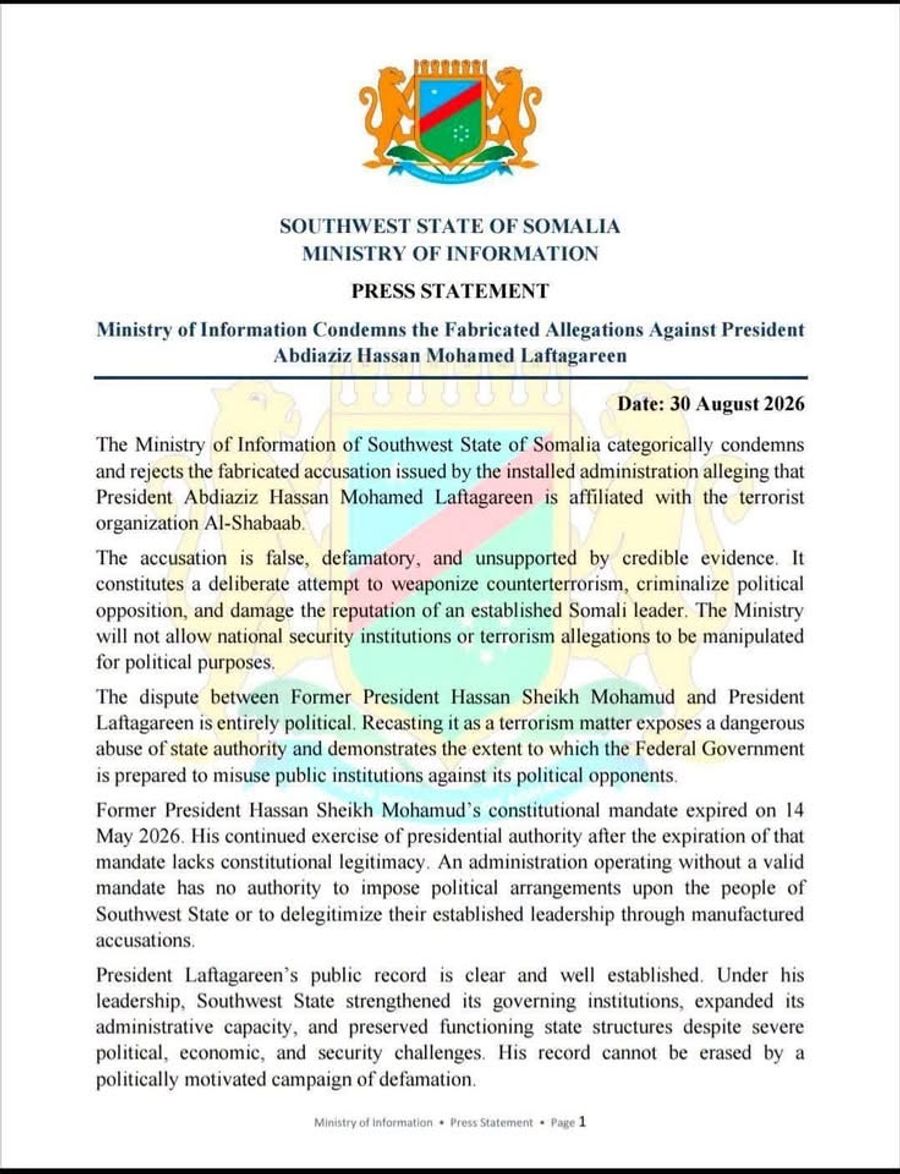
MOGADISHU, Somalia — August 31, 2026 — A Southwest State information ministry aligned with Abdiaziz Hassan Mohamed Laftagareen has rejected allegations that he maintains links with Al-Shabaab, describing the accusation by the rival administration backed by Aden Madobe as fabricated, defamatory and unsupported by credible evidence.
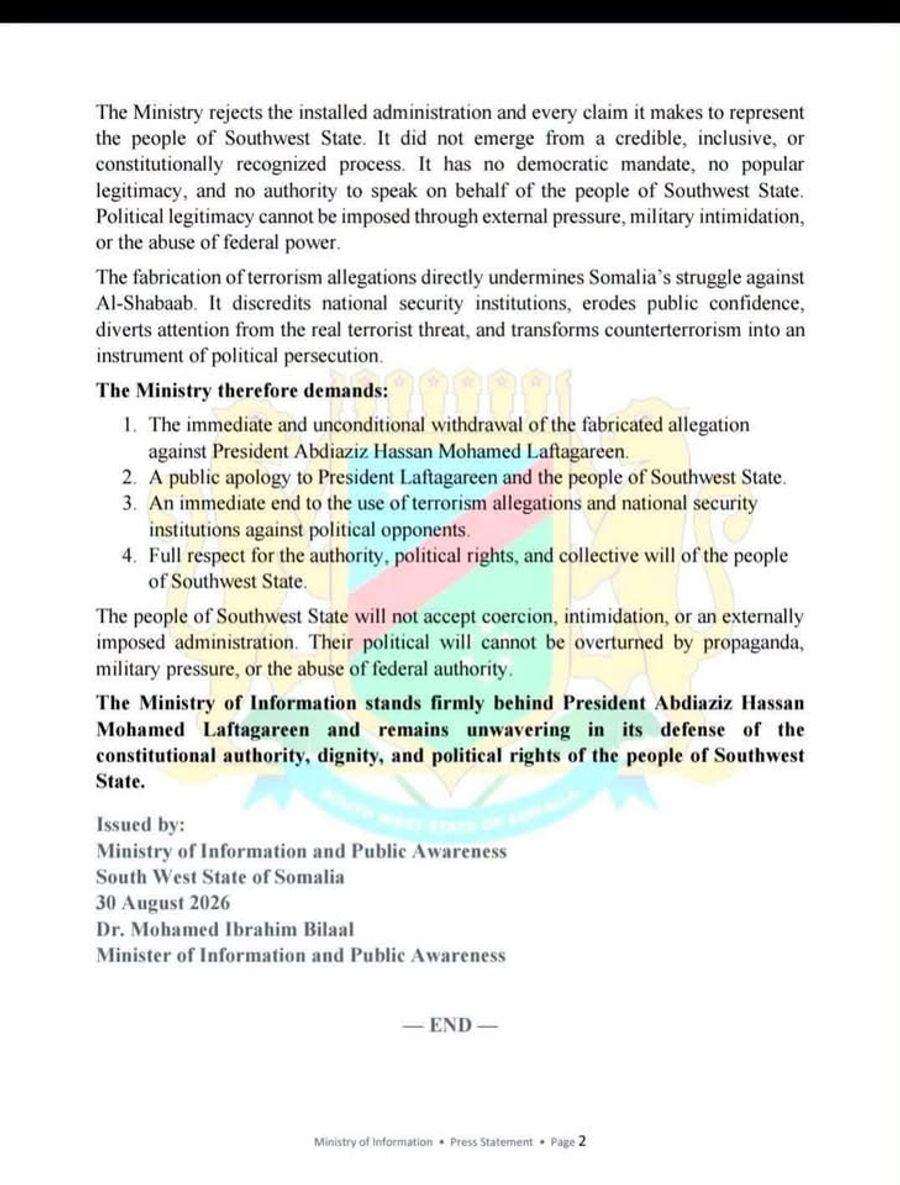
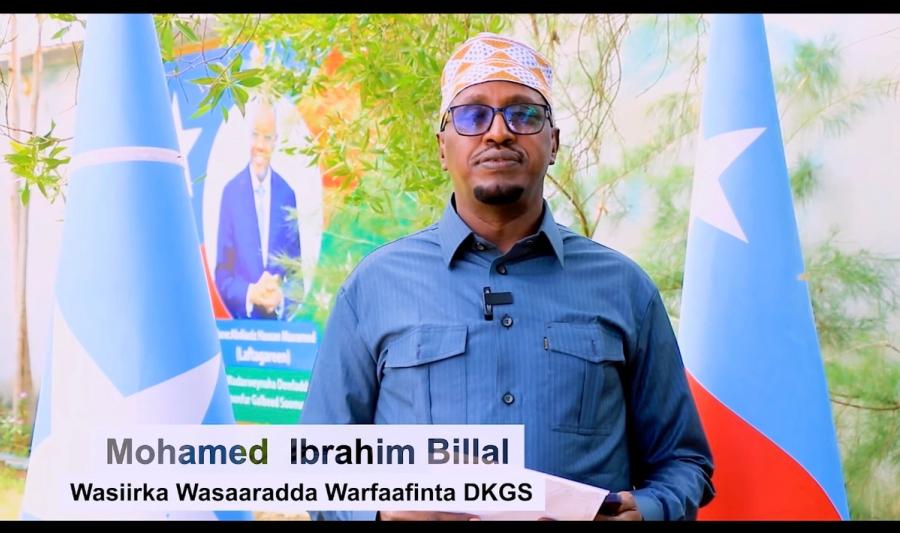
The statement was issued by Dr. Mohamed Ibrahim Bilaal, who serves as information and public awareness minister in the Laftagareen-aligned administration. It referred to the competing Southwest leadership as an “installed administration” and challenged its authority to represent the people of the federal member state.
The ministry said the dispute involving Laftagareen and the federal leadership was political and should not be presented as a counterterrorism matter. It warned that using accusations involving Al-Shabaab in a political confrontation could weaken confidence in Somalia’s national security institutions and divert attention from the armed group’s continuing threat.
Al-Shabaab, which is affiliated with Al-Qaeda, has waged an insurgency against the Somali government and its international partners for years. Somali authorities commonly refer to its members as “Khawarij,” a term rejected by the militant group.
Ministry Demands Withdrawal and Apology
The Laftagareen-aligned ministry issued four demands, including the immediate and unconditional withdrawal of the allegation and a public apology to Laftagareen and residents of Southwest State.
It also called for an end to what it described as the use of terrorism allegations and national security institutions against political opponents.
The ministry demanded recognition of the political rights and collective will of Southwest State residents. It said political legitimacy should not be imposed through external pressure, military intimidation or federal authority.
“The fabrication of terrorism allegations directly undermines Somalia’s struggle against Al-Shabaab,” the ministry said in its statement. It argued that such claims could discredit security institutions, erode public confidence and turn counterterrorism into a tool of political persecution.
These assertions represent the position of the Laftagareen-aligned camp and have not been independently established.
Competing Claims of Legitimacy
The statement comes amid a widening confrontation between rival political camps claiming authority in Southwest State.
Laftagareen and his supporters have rejected the legitimacy of the Aden Madobe-backed administration. They say it did not emerge from a credible, inclusive or constitutionally recognized process and accuse the federal government of interfering in the internal affairs of the regional state.
The opposing camp disputes Laftagareen’s continuing claim to the presidency and has sought to establish a separate administration in Baidoa, the interim capital of Southwest State.
Both sides have used increasingly forceful language while presenting themselves as the lawful representatives of the region. Their competing claims have intensified uncertainty over political authority, command of regional security forces and relations between Southwest State and Somalia’s federal government.
The information ministry also defended Laftagareen’s record in office, saying his administration had strengthened governing institutions and maintained state structures despite political, economic and security pressures.
It accused the rival camp of conducting a politically motivated campaign intended to delegitimize Laftagareen and his supporters. No evidence supporting an organizational or operational connection between Laftagareen and Al-Shabaab was presented in the ministry’s statement because the document was a denial of the allegation.
Southwest State has faced growing political and security tensions as supporters of Laftagareen and Aden Madobe compete for influence. The dispute has extended beyond political statements, affecting the alignment of regional forces and raising concerns about possible armed confrontations.
Laftagareen-aligned officials have previously called on the African Union Support and Stabilization Mission in Somalia, known as AUSSOM, and other international partners to remain neutral in the regional political dispute.
The rival sides have also traded accusations over the role of the federal government. Laftagareen’s supporters allege that Mogadishu is using federal institutions to weaken established regional leaders, while their opponents argue that political change is necessary and challenge the legitimacy of his continued leadership.
The dispute is unfolding while Southwest State remains a major front in Somalia’s campaign against Al-Shabaab. The militant organization retains a presence in parts of Bay, Bakool and Lower Shabelle, restricting movement and threatening civilians, government officials and security personnel.