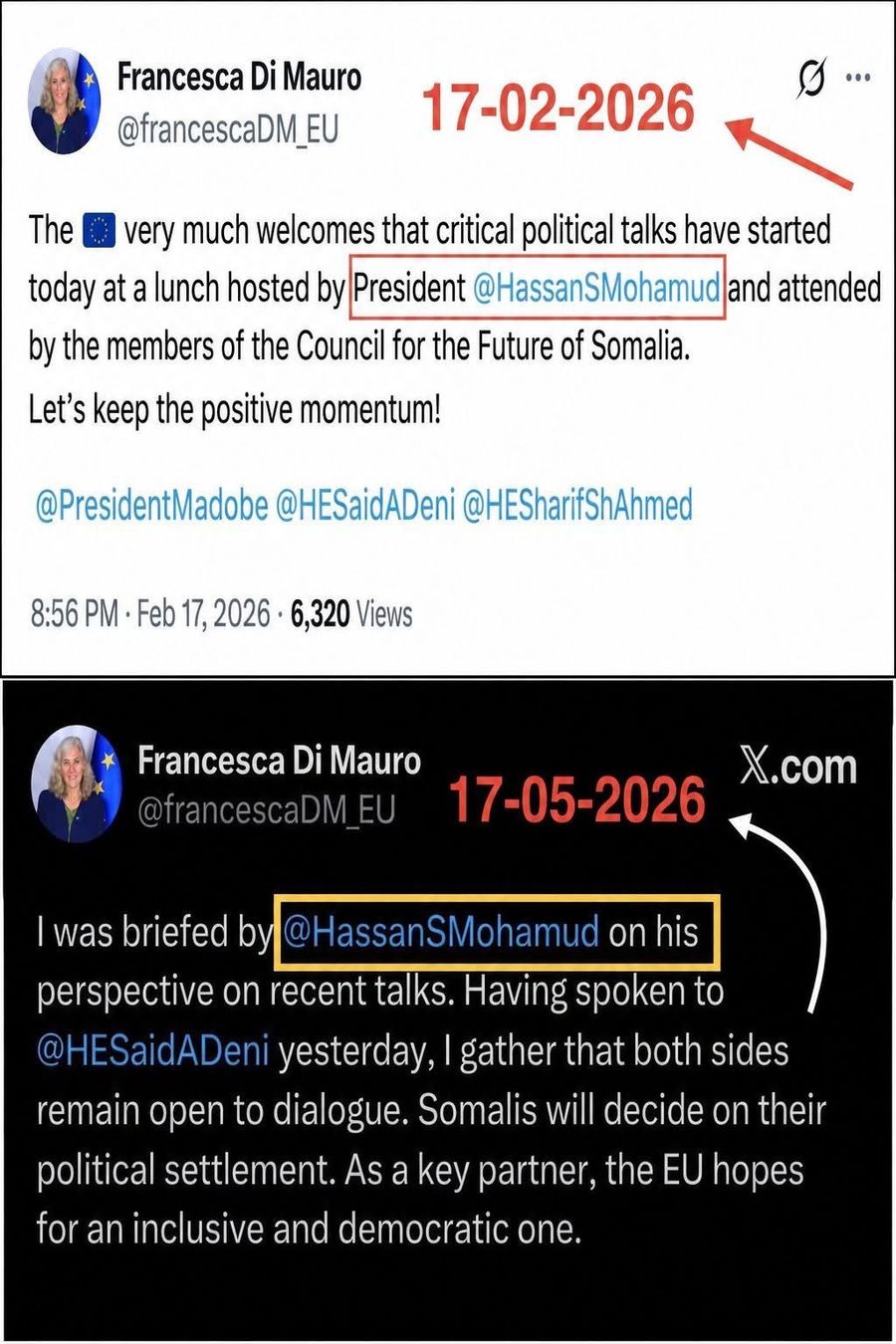
Sunday, May 17, 2026 (Baidoa Online) -Full Analysis in the Somali Context
- 1. Political sensitivity over legitimacy debates – The EU may be avoiding language that could be interpreted as taking sides in Somalia’s internal political disputes.
- 2. Increasing opposition pressure – Opposition groups in Somalia have been challenging the interpretation of the presidential mandate timeline, making diplomatic wording more cautious.
- 3. Diplomatic neutrality strategy – International partners often adjust terminology to remain neutral during politically contested periods.
- 4. Divergence in messaging with Villa Somalia – Differences between EU and government statements may reflect coordinated caution rather than open disagreement.
- 5. Post-mandate political uncertainty claims – Discussions around the 15 May 2026 mandate end-date have increased sensitivity around official titles.
- 6. Avoiding escalation of political tensions – Using or avoiding the term “President” can be interpreted politically, so omission may be a risk-management approach.
- 7. Consistency in EU communications – The EU may be standardizing language across all statements to avoid repeated diplomatic scrutiny.
- 8. Signal of institutional rather than personal engagement – Focusing on “institutions” instead of individuals may reflect EU emphasis on governance structures.
- 9. Domestic audience interpretation risks – Any terminology used by foreign diplomats can be amplified in Somali media and political discourse.
- 10. Maintaining leverage for dialogue facilitation – Neutral language helps the EU position itself as a mediator among Somali political actors rather than a partisan actor.