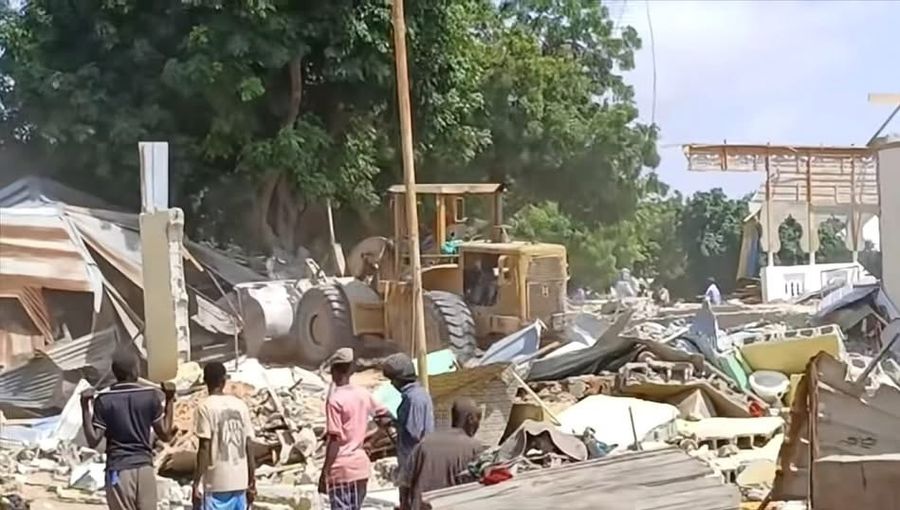
MOGADISHU, Somalia — September 1, 2026 — Government-led land clearances and forced evictions in Mogadishu are raising concerns about their wider economic impact, as affected families face the loss of homes, livelihoods and savings at a time of rising living costs.
Authorities describe the operations as part of efforts to reclaim public land, open roads and modernise the capital. Residents and opposition leaders, however, accuse officials and powerful business interests of using redevelopment to seize valuable property. The legality of individual transactions remains disputed, but the economic risks extend beyond land ownership.
For affected households, losing a home can also mean losing a workplace, a source of rental income, access to customers and years of investment. Without adequate compensation and practical resettlement support, demolition can push families deeper into poverty while disrupting the businesses and services around them.
The pressure comes as Somalia’s economic growth slows. Official statistics estimate that the economy grew by 3.1 percent in 2025, compared with 4 percent in 2024. Meanwhile, national consumer prices rose by 6.7 percent in the year to July 2026. Food prices increased by 7.9 percent, while housing and utilities costs rose by 8.6 percent.
These figures do not show how much economic damage has been caused by evictions. They do, however, demonstrate that families are being asked to absorb the cost of displacement when basic necessities are already becoming more expensive.
The first financial shock is the destruction or loss of household assets. Families may have spent years building their homes, installing electricity, buying furniture or establishing small shops. Even where ownership of the underlying land is contested, those investments can represent much of a household’s accumulated wealth.
Once displaced, families need money immediately for transport, temporary accommodation, replacement shelter and essential belongings. These expenses can arrive just as work and business activities are interrupted.
Households with savings may exhaust them. Others may borrow from relatives, sell productive assets or seek additional support from family members abroad. Such support can prevent immediate destitution, but it may divert money previously intended for education, healthcare or business investment.
The next effect is a reduction in purchasing power. When a larger share of income goes towards rent, moving costs and rebuilding, less remains for food, medicine, school fees and other necessities.
Somalia’s 2022 household survey found that more than half the population lived below the national poverty line. It also showed that purchases accounted for 93 percent of food consumption. Although these are historical figures, they illustrate how closely food security depends on households having money to spend.
For a family already struggling to meet basic needs, losing shelter can therefore become a hunger crisis. Food may remain available in the market, but the household may no longer be able to afford enough of it.
The consequences spread to local businesses. Small shops, food sellers, tailors and other traders depend on customers living and working nearby. When a neighbourhood is cleared, businesses can lose their customer base, trading space and storage facilities at the same time.
A home-based business is especially vulnerable because the loss of a residence also removes its premises. Restarting elsewhere may require new equipment, additional rent and time to rebuild relationships with customers and suppliers.
Displaced customers may also buy less or request goods on credit. This transfers some of the financial pressure to shopkeepers, who still need to pay suppliers and maintain their own households.
Some commercial activity will move to other neighbourhoods, and redevelopment can create construction jobs. However, those gains do not automatically compensate for lost businesses, damaged equipment and interrupted earnings. The overall economic outcome depends on how quickly affected people can resume productive work.
Relocation can also make employment harder to maintain. A household moved farther from markets, construction sites or other workplaces may face higher transport expenses and longer journeys.
A free or inexpensive plot does not necessarily make a family financially secure if it is far from employment and lacks affordable services. The real cost of resettlement includes transport, water, electricity, schooling and access to healthcare.
Women combining childcare with home-based work may face particular difficulties. Moving away from relatives and trusted neighbours can disrupt informal childcare arrangements and make it harder to continue earning an income.
The real estate sector faces another problem: uncertainty over property rights.
Buyers and developers need confidence that ownership documents will be recognised and disputes resolved fairly. Where residents believe documents cannot protect their property, potential investors may delay purchases, demand lower prices or spend more on legal checks.
This does not mean that Mogadishu’s entire property market is collapsing. Different parts of the market may respond differently. Secure properties could attract higher demand, while disputed plots become harder to sell.
At the same time, removing inexpensive accommodation can increase pressure on nearby rental housing if suitable alternatives are limited. New commercial buildings or expensive residential developments may add to the city’s property stock without meeting the needs of displaced low-income families.
Reliable data are not available to establish how much the current clearances have changed Mogadishu’s rents, property prices or business activity. Claims of a specific citywide increase or decline would therefore be premature.
Financial pressures can extend to borrowing. Property with disputed ownership may be less useful as security for a loan, while households and traders whose earnings fall may struggle to repay existing debts.
Some families may sell tools, equipment or business stock to meet immediate shelter needs. That can solve a short-term problem while weakening their ability to earn in the future, prolonging dependence on borrowing or assistance.
The loss of community infrastructure adds another economic burden. An assessment of major eviction incidents in Mogadishu between January and October 2022 identified approximately $3.49 million in lost humanitarian and community infrastructure investment.
That historical figure is not an estimate of losses from the current campaign. It nevertheless shows that eviction can destroy assets beyond individual homes, including facilities that provide sanitation, education and healthcare.
Replacing such infrastructure consumes money that could otherwise expand services. Interrupted schooling can affect children’s future opportunities, while reduced access to clean water and healthcare can increase illness, treatment expenses and time away from work.
These risks are more serious when humanitarian assistance is limited. Newly displaced families may need additional food, shelter and healthcare support at a time when aid organisations are already struggling to meet existing needs.
Public land transactions also have consequences for government finances. Transparent sales or leases can raise money for infrastructure and public services. But the economic value of a transaction depends on the price received, how the beneficiary is selected and whether the proceeds reach the public budget.
Selling valuable land below its fair value would reduce public wealth. Redevelopment also carries costs, including compensation, resettlement and replacement infrastructure, which must be included when assessing whether a project benefits the city.
The government has announced a resettlement programme for more than 1,000 families in Gubadley, with plans for essential services. Its economic success will depend on implementation: whether families receive habitable shelter, secure tenure, functioning services and reasonable access to jobs.
Providing land is an important step, but a household’s recovery requires more than a plot. Families must also be able to rebuild their income and meet everyday expenses without falling into deeper debt.
A clear assessment of the programme should track compensation paid, homes completed, businesses reopened, employment restored and changes in household living costs. Publishing land valuations and transaction records would also help address public concerns about who benefits from redevelopment.
Mogadishu needs better roads, housing and public services. Well-planned redevelopment can improve productivity and living standards. But when families lose assets and livelihoods without adequate support, the economic costs can continue long after demolition ends.
The measure of successful urban development is whether residents gain safer homes, stronger livelihoods and better access to opportunity. Without those outcomes, the capital risks expanding its physical infrastructure while weakening the households and businesses that sustain its economy