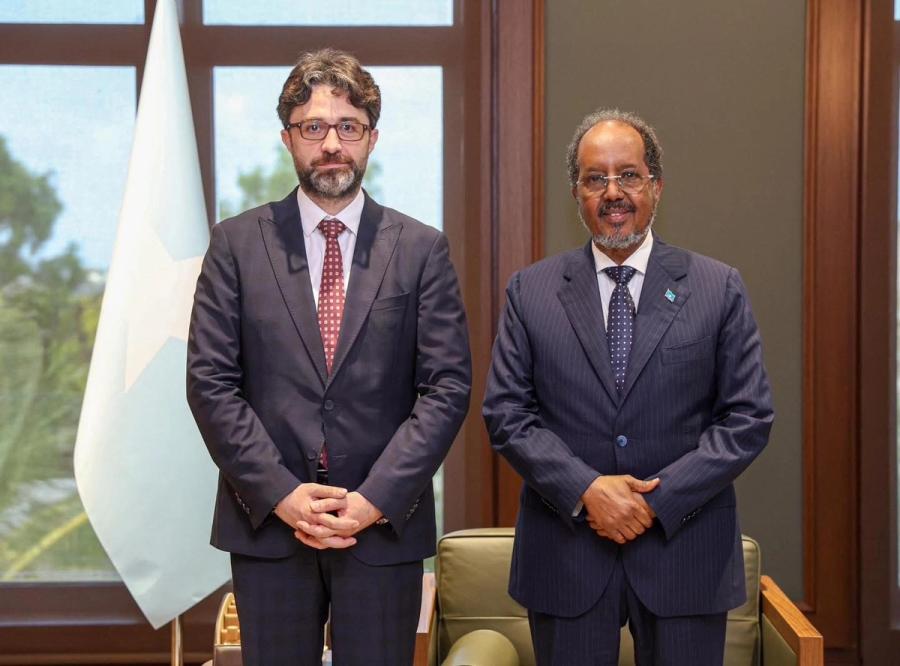
Saturday , May 16, 2026 (Baidoa Online) -President Hassan Sheikh Mohamud has held talks at Villa Somalia with Turkey’s Ambassador to Somalia, Alper Aktaş, shortly after inconclusive political negotiations between Somali leaders at the Xalane compound, according to the Presidency.
The meeting took place amid rising political tensions in the country following disputes over the electoral process and questions surrounding the end of the current administration’s mandate. The situation has deepened divisions between the Federal Government and opposition groups.
According to a statement from the Presidency, the discussions focused on strengthening bilateral relations between Somalia and Turkey, including cooperation in security, development, and regional issues in the Horn of Africa.
According to the Presidential Office, President Hassan Sheikh Mohamud and Ambassador Alper Aktaş discussed ways to enhance the long standing strategic partnership between Somalia and Turkey.
The talks reportedly included areas of security cooperation, institutional development, humanitarian support, and ongoing development projects supported by Turkey in Somalia.
The meeting came just hours after opposition led political talks at the Xalane compound ended without agreement on key issues related to Somalia’s political future and electoral framework.
According to political sources familiar with the discussions, the Xalane talks failed to bridge differences between the Federal Government and opposition groups over the structure and timeline of upcoming political arrangements. These claims have not been independently verified.
Turkey remains one of Somalia’s most significant international partners. It has been involved in training Somali security forces, supporting infrastructure development, and providing humanitarian and institutional assistance.
Government Position
According to the Presidency, Somalia values its strategic partnership with Turkey and continues to seek expanded cooperation in areas of national security and development.
Officials have not publicly linked the meeting with the recent political deadlock. However, the timing has drawn attention due to its proximity to stalled negotiations between Somali political actors.
The Federal Government has not issued additional statements regarding the outcome of the Xalane talks.
Opposition Reaction
Opposition groups and some federal member state actors have previously raised concerns about the political process and have called for broader inclusive negotiations.
According to opposition figures, Somalia’s political future should be determined through consensus among all major stakeholders to avoid further escalation of tensions.
No formal response has been issued by opposition leaders regarding the presidential meeting with the Turkish ambassador.
Somalia is currently facing a politically sensitive period marked by disagreements over electoral arrangements and constitutional interpretations.
In recent years, political dialogue has played a central role in managing disputes between the Federal Government, opposition groups, and regional administrations. However, several rounds of talks have ended without lasting agreement.
Turkey has maintained a strong presence in Somalia for more than a decade, providing support in security sector development, infrastructure projects, and humanitarian assistance programs.
The Xalane compound in Mogadishu has often served as a venue for high level political negotiations involving Somali leaders and international partners.
It remains unclear whether renewed political talks will be scheduled following the latest breakdown in negotiations at Xalane.
Attention is now focused on whether the Federal Government and opposition groups will return to the negotiating table or whether political divisions will deepen further.
The government is expected to continue its diplomatic engagements with international partners while managing domestic political pressure.
The meeting between President Hassan Sheikh Mohamud and the Turkish ambassador comes at a time of heightened political uncertainty in Somalia.
It highlights the continued role of international partners in Somalia’s political and development landscape, especially during periods of domestic political tension.
The timing of the engagement has drawn attention because it follows closely after failed political talks, raising questions about how domestic and international diplomacy intersect during moments of political deadlock.