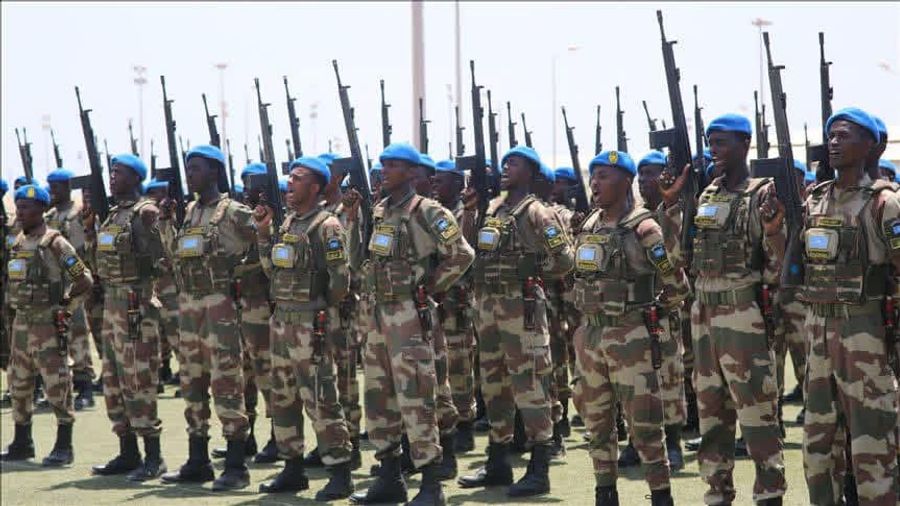
MOGADISHU, Somalia — Puntland and Jubaland have reportedly asked the international community to consider restoring restrictions on arms supplies to Somalia, arguing that the Federal Government lacks the political consensus and institutional safeguards needed to manage advanced weapons responsibly.
According to diplomatic sources, the two federal member states presented their concerns in separate letters circulated to foreign embassies accredited to Somalia, the United Nations, the African Union and the Intergovernmental Authority on Development, or IGAD.
The letters themselves have not been made public, and their authenticity and full contents could not be independently verified. The Federal Government had not publicly responded to the reported requests at the time of publication.
The most consequential demand is the proposed return of the UN arms embargo on the Somali government. Puntland and Jubaland reportedly argued that weapons and military equipment acquired for national security operations were increasingly at risk of being used in domestic political disputes.
They also raised concerns that heavy weapons and armed drones could fall into the hands of Al-Shabaab or other militant organisations because Somalia lacks a nationally agreed security structure and an effective system for controlling military equipment.
Reversing a Major Diplomatic Achievement
The request challenges one of Mogadishu’s most significant diplomatic victories.
The UN Security Council imposed a general arms embargo on Somalia in 1992 as the country descended into civil war. Restrictions were gradually eased after the Federal Government was established, including a partial suspension in 2013 that allowed weapons to be supplied for rebuilding Somali security forces.
In December 2023, the Security Council unanimously lifted the remaining embargo on weapons deliveries to the Federal Government under Resolution 2714. A separate sanctions regime against Al-Shabaab remained in force.
The Somali government welcomed the decision as recognition of progress in rebuilding national institutions and strengthening its capacity to fight militant organisations. However, Puntland and Jubaland’s reported appeal suggests that political divisions between Mogadishu and some federal member states are now affecting international confidence in the management of Somalia’s expanding military capabilities.
Restoring the previous restrictions would require action by the Security Council. Letters from federal member states could influence discussions, but Puntland and Jubaland cannot independently reimpose an international embargo.
Election and Legitimacy Dispute
The two administrations also reportedly called for an inclusive electoral process to resolve disputes over the mandates of the Federal Government and regional administrations in southern Somalia.
They accused the federal authorities of losing the legitimacy attached to their original constitutional mandate. That claim remains politically contested: the Federal Government continues to enjoy international recognition as Somalia’s sovereign national authority, while its opponents dispute the legality and inclusiveness of recent constitutional and electoral decisions.
The present confrontation has developed over several years. Puntland announced in March 2024 that it would operate independently of federal institutions until constitutional amendments approved in Mogadishu were subjected to an inclusive national process and referendum. The federal authorities defended the changes as necessary for moving Somalia towards direct elections.
Relations between Jubaland and Mogadishu also deteriorated sharply following disagreements over the electoral process and President Ahmed Mohamed Islam Madobe’s re-election in November 2024. Jubaland suspended cooperation with the Federal Government, while both sides exchanged accusations of violating the constitutional order.
These disputes have weakened the National Consultative Council, previously the main forum for negotiations between federal and regional leaders.
International Mediation Proposed
Puntland and Jubaland reportedly asked for the establishment of an international mediation committee led by UN Security Council members and countries contributing troops to Somalia.
Such a body, they argued, could facilitate negotiations over elections, constitutional arrangements and security responsibilities before political disagreements lead to wider armed confrontation.
However, direct international mediation would be diplomatically sensitive. Mogadishu has repeatedly maintained that disputes between the Federal Government and federal member states are internal Somali matters that should be resolved through nationally led dialogue.
The reported letters also called for alternative channels through which international institutions could obtain information about Somalia’s political and security situation. This reflects claims by the two administrations that reports provided by federal authorities do not fully represent conditions across the country.
Dollow Airstrike Investigation
Another demand concerns an alleged airstrike in Dollow on September 3, 2026. Puntland and Jubaland reportedly requested an independent international investigation to establish responsibility and determine whether the operation violated domestic or international law.
Dollow has been a significant flashpoint in tensions between Jubaland and the Federal Government. The town sits near Somalia’s borders with Ethiopia and Kenya and has strategic importance for military movements, trade and humanitarian operations.
Future of UN and AU Missions
The letters further requested an extension of the United Nations Transitional Assistance Mission in Somalia, or UNTMIS, to protect achievements in state-building and counterterrorism.
UNTMIS replaced the United Nations Assistance Mission in Somalia in November 2024 as part of a planned transition requested by the Federal Government. Its functions include supporting political dialogue, constitutional priorities, human rights and coordination between Somali authorities and international partners. Its drawdown is expected to conclude in October 2026, although the precise timetable remains subject to Security Council decisions. The UN says UNTMIS was established under Resolution 2753.
Puntland and Jubaland reportedly want an urgent formal discussion on Somalia before the mission closes and before the end of the current mandate period for the African Union Support and Stabilization Mission in Somalia, known as AUSSOM.
The dispute places international partners in a difficult position. Reinstating arms restrictions could weaken federal counterterrorism operations at a time when Al-Shabaab remains a major threat. Ignoring concerns about weapons management and political fragmentation, however, could deepen distrust and increase the danger that national security resources become entangled in internal political confrontations.
The immediate significance of the letters therefore extends beyond the specific demands they contain. They represent an attempt by two influential federal member states to internationalise Somalia’s constitutional and security dispute—and to persuade foreign partners that the country’s political divisions now pose a direct threat to its security transition.