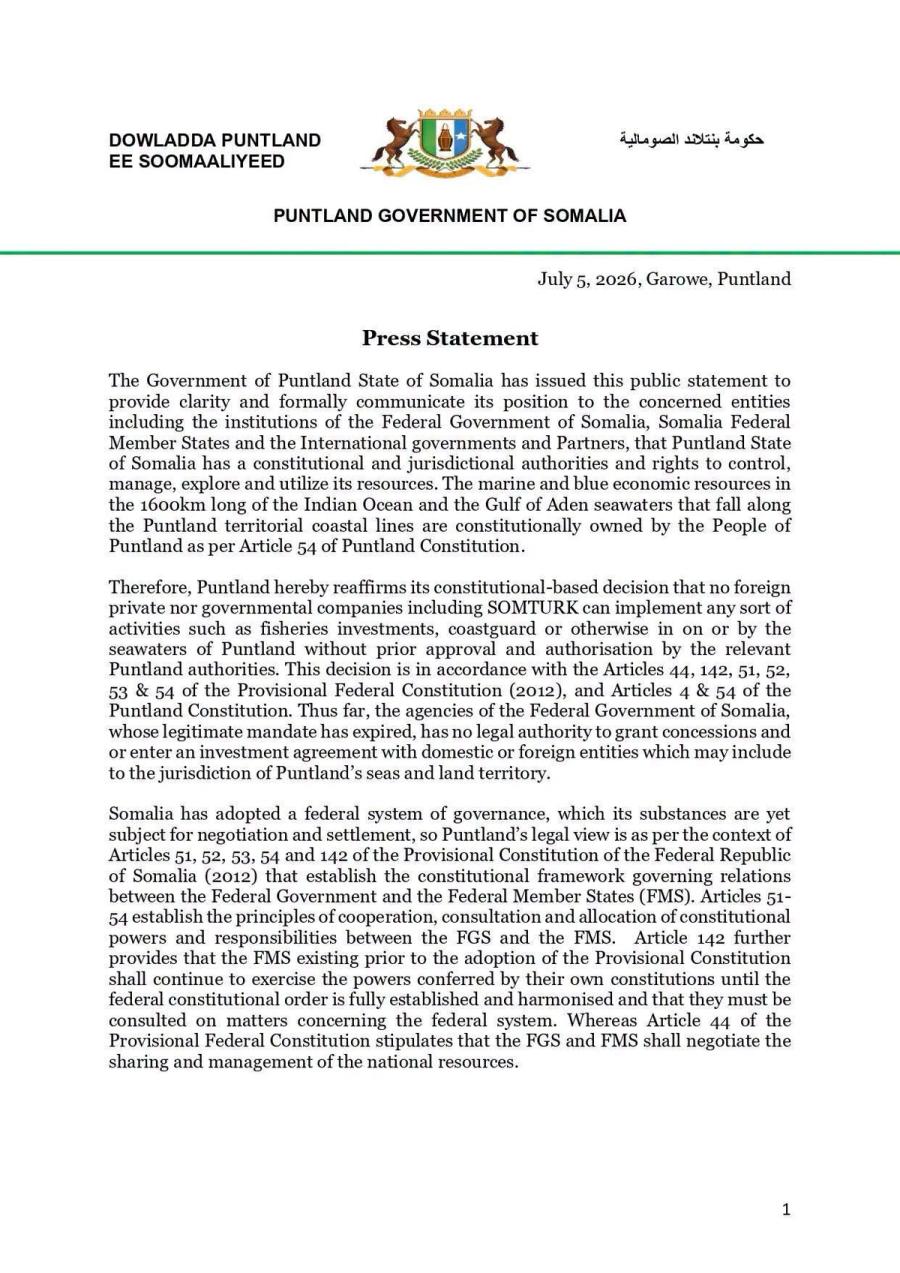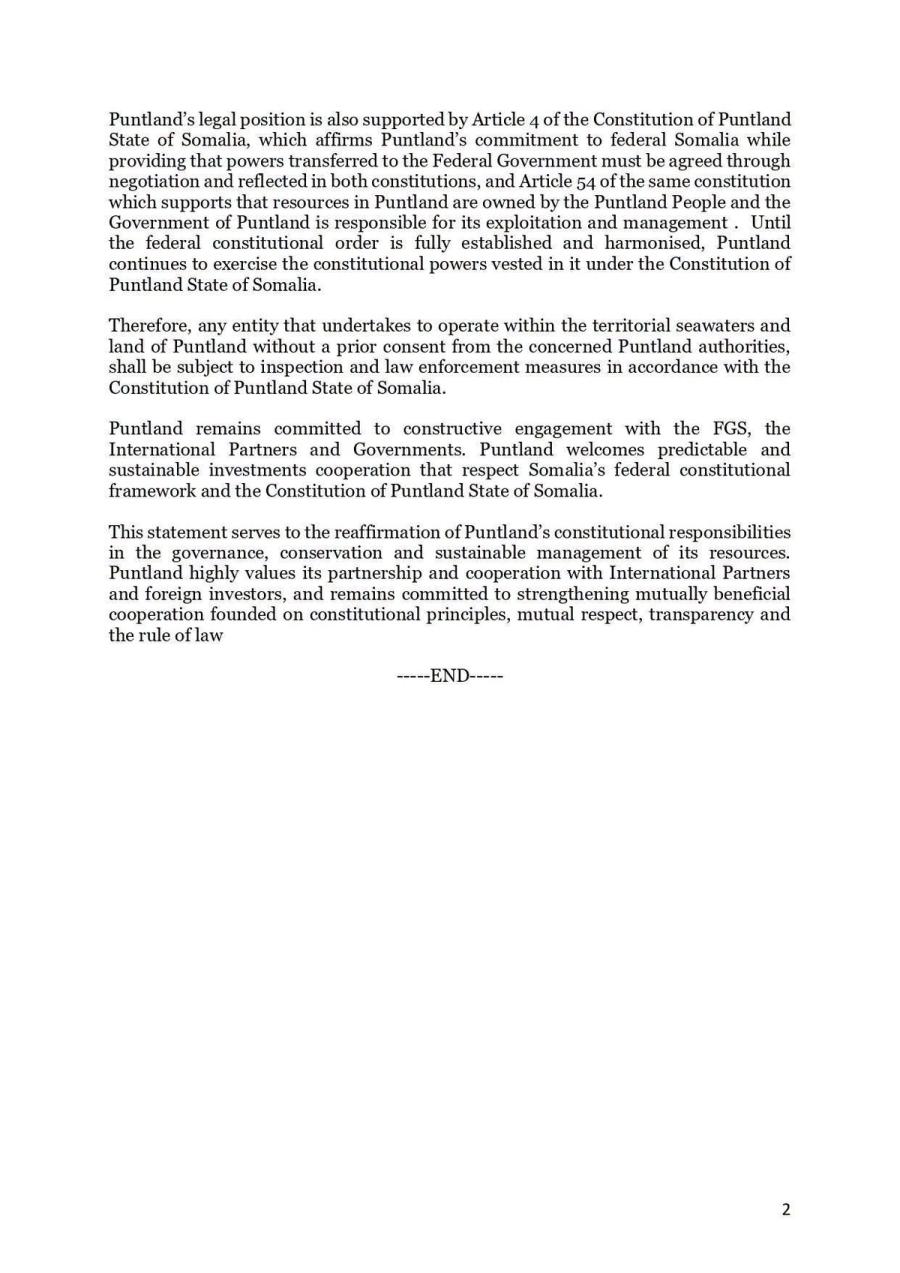
MOGADISHU, Somalia — July 5, 2026 — Puntland authorities have declared that they retain exclusive constitutional authority over the management, protection, and utilization of natural resources within their territory and maritime areas, warning that foreign entities, including the Turkish-linked company SOMTURK, cannot operate in Puntland without the administration’s approval.
The statement, issued by the Puntland government, also challenged the authority of Somalia’s Federal Government to grant licenses or enter into agreements concerning resources located within Puntland without prior consultation and agreement with the regional administration.
Latest Developments
In a press release, Puntland said its position is based on provisions contained in both the Puntland Constitution and Somalia’s Provisional Federal Constitution.
The regional administration stated that no foreign company or institution, including SOMTURK, would be permitted to conduct activities within Puntland’s territory or maritime zones unless it first obtains authorization from Puntland authorities.
Officials said the administration would take legal and administrative action against any individual, company, or organization found operating without the required approvals.
The statement also warned that Puntland’s security and oversight agencies would carry out investigations, monitoring operations, and enforcement measures to prevent what it described as unauthorized activities in its coastal and territorial areas.
According to Puntland authorities, any attempt to exploit resources within the region without its consent could result in penalties and other legal consequences under applicable laws and regulations.
Government Response
Puntland accused Somalia’s Federal Government of exceeding its authority by issuing agreements or licenses related to resources located within Puntland without reaching an agreement with the regional administration.
The government argued that resource management falls under constitutional arrangements that require cooperation and consultation between federal and regional authorities.
Federal authorities had not immediately responded publicly to Puntland’s latest statement at the time of publication.
The declaration comes amid continued debates between Mogadishu and several federal member states over the division of powers, resource governance, and revenue-sharing mechanisms.
Dispute Over Resource Authority
The latest disagreement centers on questions surrounding who has the authority to approve exploration, extraction, and development projects involving natural resources in Puntland’s territory and adjacent maritime areas.
Puntland maintains that it possesses constitutional powers to administer resources within areas under its jurisdiction. The administration has repeatedly emphasized that any investment, exploration, or development project must comply with Puntland laws and regulations.
The reference to SOMTURK in the statement suggests growing concern within Puntland over reported plans or activities involving Turkish-linked commercial interests, although officials did not provide detailed information regarding specific projects in the latest release.
Background & Context
Disagreements over natural resource governance have been a recurring feature of Somalia’s federal system since the adoption of the Provisional Federal Constitution.
Successive administrations in Mogadishu and federal member states have differed on how powers should be divided regarding petroleum exploration, mineral extraction, fisheries, and offshore resources.
Puntland has historically asserted significant autonomy in managing its economic and natural resources, arguing that federal arrangements require consensus and cooperation between different levels of government.
Questions surrounding ownership, licensing authority, revenue sharing, and regulatory oversight have remained unresolved in several sectors, particularly those involving offshore resources and foreign investment.
The issue has gained additional significance as Somalia seeks to attract international investors and expand economic development opportunities linked to its coastline and natural resource potential.
Political disagreements over resource management have occasionally generated tensions between federal institutions and regional administrations, with both sides citing constitutional provisions in support of their respective positions.
The dispute is likely to increase pressure on federal and regional authorities to clarify legal frameworks governing resource development and foreign investment projects.
Any attempt by companies to begin operations in disputed jurisdictions could face legal challenges or administrative obstacles if agreements are not reached between the relevant authorities.
Observers say future negotiations between Mogadishu and Puntland may determine how resource governance issues are handled and whether mechanisms can be established to reduce recurring disputes over licensing and resource control.
For now, Puntland has reiterated that no foreign company, including SOMTURK, may operate within its territory or maritime areas without its explicit approval.
The dispute highlights one of the most significant unresolved issues within Somalia’s federal system: the division of authority over natural resources and economic assets. Clarity on these questions is considered essential for attracting investment and ensuring legal certainty for companies seeking to operate in the country.
The disagreement could also affect future energy, fisheries, and infrastructure projects if investors face competing claims of authority from federal and regional institutions. Uncertainty over licensing and regulatory oversight may increase commercial risks for foreign firms.
Politically, the issue reflects broader tensions between Mogadishu and federal member states regarding constitutional powers and governance arrangements. Similar disputes have emerged in the past over revenue sharing, security responsibilities, and administrative authority.