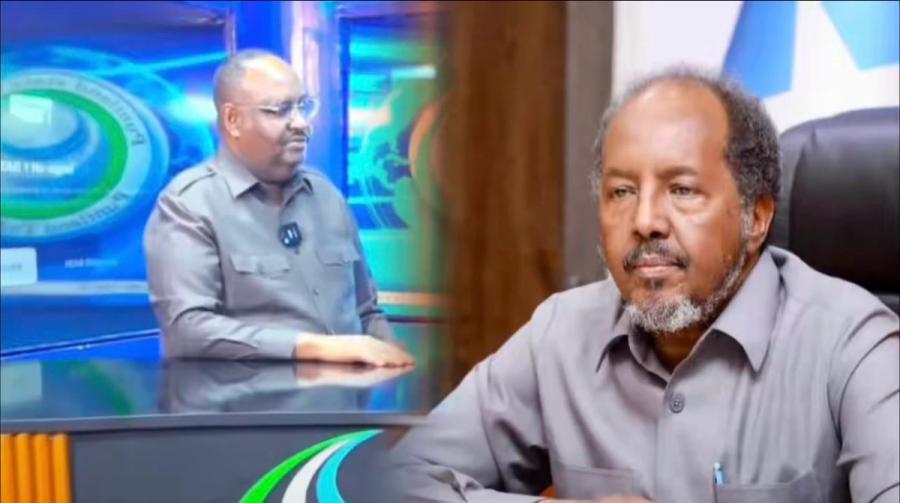
MOGADISHU, Somalia — October 31, 2026 — Puntland President Said Abdullahi Deni has called on Somali President Hassan Sheikh Mohamud to resign and transfer power to a temporary national salvation council, warning that Somalia is facing an increasingly dangerous political and security crisis that threatens the country’s stability, constitutional order and federal system.
In strongly worded remarks, Deni accused the Somali president of failing to address the country’s mounting challenges, arguing that the political situation had deteriorated beyond what the current administration could manage through negotiations, financial incentives or political arrangements.
“President Hassan Sheikh has reached a point where the situation is beyond his understanding and beyond what he can resolve through money and political deals. He should hand over the country to a temporary council that can save it,” Deni said, according to a translation of his Somali-language remarks.
The Puntland leader also issued a direct appeal for the president to step aside.
“I call on Hassan Sheikh to put the country’s interests first and resign,” he declared.
Deni warned that Somalia was confronting multiple crises simultaneously, arguing that discussions about elections were inappropriate while political instability and security tensions continued to intensify.
“The country is facing enormous dangers, and everywhere is burning. Today is not the time to talk about elections,” he said.
His comments represent a significant escalation in the political confrontation between Puntland’s leadership and the Federal Government of Somalia, coming amid a prolonged constitutional dispute over presidential authority, electoral arrangements and the relationship between Mogadishu and federal member states.
Somalia’s Political Stalemate Deepens
Somalia has been experiencing a major political deadlock since May 2026, when President Hassan Sheikh Mohamud’s original four-year constitutional term was due to expire.
The dispute intensified following constitutional amendments approved by the Somali Parliament that established five-year terms for the presidency and federal legislature.
The federal government maintains that the revised constitutional framework allows President Hassan Sheikh Mohamud to remain in office until May 2027.
However, opposition leaders, including the presidents of Puntland and Jubaland, reject applying the changes to the current administration. They argue that the president’s original mandate expired on May 15, 2026, while Parliament’s previous mandate ended on April 14.
The competing constitutional interpretations have produced a prolonged political stalemate, with neither side accepting the other’s position on the legitimacy of the current electoral process.
The federal government argues that constitutional reforms are necessary to strengthen democratic institutions and move Somalia toward direct elections.
Opposition groups maintain that constitutional amendments affecting national leadership and electoral procedures require broader political agreement, particularly among federal member states.
The dispute has also raised questions about the future of Somalia’s federal power-sharing arrangements and the authority of national institutions.
Puntland and Jubaland Reject Federal Election Timetable
Political tensions escalated further after Somalia’s National Independent Electoral and Boundaries Commission announced an electoral timetable on October 15.
Under the announced schedule, elections for both houses of the Federal Parliament are planned for April 15, 2027, followed by a presidential election on May 15, 2027.
Puntland, Jubaland and several opposition figures rejected the timetable, arguing that it had been introduced without a comprehensive agreement among the country’s principal political stakeholders.
On October 25, Deni accused President Hassan Sheikh of abandoning consensus-based elections during an address to the Puntland Parliament in Garowe.
He argued that Somalia’s political arrangements, including the federal framework established under the 2012 Provisional Constitution, should not be altered without broad national consultation.
The federal government, meanwhile, maintains that the revised election timetable follows the country’s constitutional and electoral legislation.
Although both the government and major opposition groups have expressed support for moving toward direct voting, they remain divided over how elections should be organized, who should administer them and how federal member states should participate.
Opposition Challenges Constitutional Changes in Court
The political confrontation has also reached Somalia’s judicial institutions.
Former President Sharif Sheikh Ahmed and other opposition figures have challenged the constitutional amendments before the Supreme Court.
A petition was reportedly filed on October 11 and received by the court the following day.
The legal challenge questions the procedures used to revise the constitution and seeks judicial examination of the government’s constitutional and electoral decisions.
However, legal experts have raised questions about the court’s jurisdiction and whether the petition meets the requirements for judicial consideration.
The case highlights the increasingly difficult relationship between political negotiations, constitutional interpretation and the institutions responsible for resolving disputes.
Somali Future Council Seeks Political Settlement
The Somali Future Council, an opposition alliance that includes senior political figures and the leadership of Puntland and Jubaland, has repeatedly called for a negotiated settlement.
In September, the coalition appealed to the United Nations Security Council to support international mediation over Somalia’s constitutional and electoral disagreements.
The alliance argued that political divisions were threatening national stability and complicating security operations.
It called for an inclusive electoral framework, agreement on constitutional issues and a mechanism capable of facilitating negotiations between the federal government and its opponents.
The federal government has emphasized that Somalia’s political differences should be resolved through national institutions and dialogue.
President Hassan Sheikh has invited political stakeholders to consultations scheduled for November 14–18, 2026, aimed at discussing federal electoral arrangements.
However, opposition participation remains uncertain, reflecting the lack of trust between the competing political camps.
Deni’s latest demand for the president’s resignation introduces another contentious proposal into an already difficult negotiation process.
South West State Conflict Adds to National Tensions
The constitutional dispute is unfolding alongside growing security tensions in southern Somalia, particularly in South West State.
Political disagreements between the federal government and forces loyal to former South West State President Abdiaziz Hassan Mohamed Laftagareen have developed into armed confrontations.
Recent fighting around Baidoa and surrounding areas has raised concerns about the use of military resources in domestic political disputes.
An October analysis published by Chatham House warned that Somalia’s political crisis was becoming increasingly intertwined with regional rivalries and armed conflict.
The analysis highlighted the danger that internal confrontations could divert security resources away from operations against Al-Shabaab.
The militant group continues to control significant rural territory in southern and central Somalia and remains capable of carrying out attacks against government forces and civilian targets.
Continued political fragmentation could further complicate military coordination, particularly as Somalia works to strengthen its security institutions and reduce dependence on international forces.
UN Political Mission Ends Amid Unresolved Crisis
Deni’s remarks also coincide with the closure of the United Nations Transitional Assistance Mission in Somalia (UNTMIS) on October 31, 2026.
The mission’s departure marks the conclusion of successive United Nations political missions that have supported Somalia’s reconciliation, institution-building and electoral processes over more than three decades.
The Somali government has described the transition as an important step toward national ownership of political affairs.
However, the mission is closing without an agreed replacement mechanism to mediate the ongoing dispute between the federal government and opposition leaders.
The African Union’s security mission and United Nations humanitarian operations will continue separately.
The departure of the political mission comes at a particularly sensitive moment, with competing constitutional interpretations, unresolved election disagreements and growing tensions between federal and regional authorities.
Puntland Says It Will Defend Somalia’s Statehood
Deni has also emphasized Puntland’s historical role in efforts to preserve and rebuild Somali state institutions.
He maintained that Puntland would continue to defend Somalia’s statehood and national unity despite its disagreements with the federal leadership.
For now, Somalia’s political future remains contested between a federal government seeking to implement its revised constitutional and electoral framework and opposition leaders demanding a negotiated settlement.
With presidential authority disputed, elections scheduled for 2027 and armed tensions affecting parts of the country, Deni’s resignation demand underscores the depth of the divisions confronting Somalia’s political leadership.