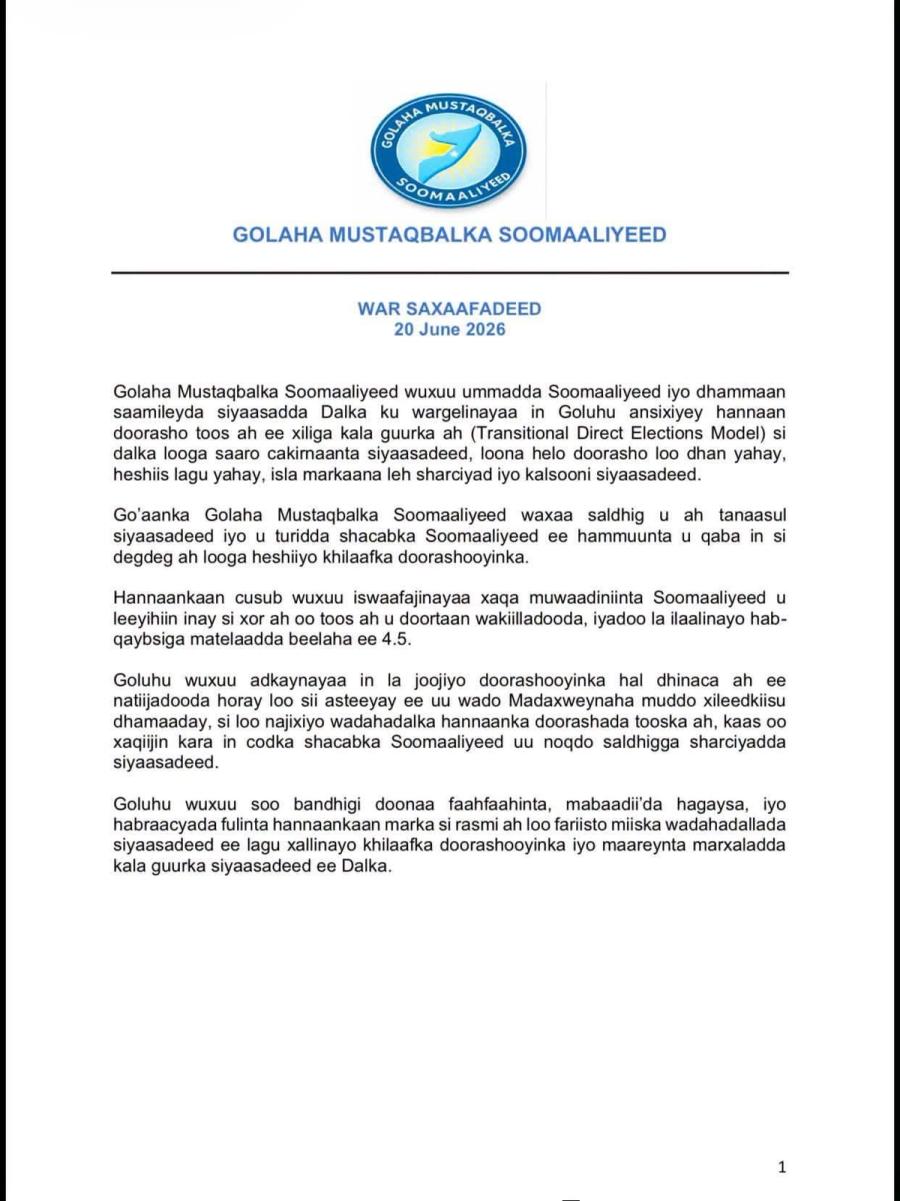
MOGADISHU, Somalia — June 20, 2026 —The Somali Future Council has approved a direct election framework based on Somalia’s 4.5 power-sharing system, according to a statement from the council. The development comes amid growing political tension in Mogadishu, where opposition groups have rejected the federal government’s push for unilateral one-person-one-vote elections.
The Somali Future Council announced that it has formally endorsed a direct electoral system built on Somalia’s existing 4.5 clan-based power-sharing arrangement, according to officials familiar with the decision.
The council said the new model aims to introduce gradual direct voting while maintaining the 4.5 system as a foundational structure for political representation and stability.
According to the statement, the framework is intended to expand citizen participation in elections while avoiding abrupt changes that could destabilize Somalia’s fragile political and security environment.
However, the announcement comes at a time of heightened political disagreement in Mogadishu over the future of Somalia’s electoral process.
Opposition political leaders have rejected the federal government’s push for what they describe as a unilateral transition to a full one-person-one-vote system, arguing that the plan lacks broad consensus and sufficient preparations.
According to opposition politicians, the government’s approach risks deepening political divisions and could undermine ongoing negotiations over constitutional and electoral reforms. They argue that any electoral model must be agreed upon by federal member states, political stakeholders, and traditional authorities.
The federal government, meanwhile, has continued to advocate for a nationwide direct election model, presenting it as a key step toward strengthening democratic governance and reducing reliance on indirect clan-based selection.
According to government officials, preparations for voter registration and electoral infrastructure development are ongoing, although implementation timelines remain unclear.
The Somali Future Council’s endorsement of a hybrid approach appears to contrast with the government’s stated preference for a full one-person-one-vote system, highlighting emerging divisions among political actors over the country’s electoral roadmap.
Officials involved in the council process said the approved framework is not yet a final constitutional amendment but rather a policy direction intended to guide further consultations between federal authorities, regional states, and the National Independent Electoral Commission.
The role of federal member states remains central to the debate, as Somalia continues to navigate power-sharing arrangements under its federal system. Some regional administrations have previously expressed concerns about the feasibility of nationwide direct elections under current security conditions.
According to sources close to the discussions, technical committees will now work on refining the electoral framework, including voter eligibility, constituency design, and implementation stages.
Security considerations and logistical challenges are expected to be key issues in upcoming consultations, particularly in areas where government control remains limited.
The federal electoral commission is expected to play a central role in advising on the operational feasibility of both the government’s proposed model and the Somali Future Council’s endorsed framework.
Somalia has been engaged in long-standing debates over its electoral system since the collapse of central authority in 1991. The 4.5 power-sharing formula has served as a transitional political arrangement, allocating parliamentary representation among major clan families while smaller groups share a combined half allocation.
Over successive election cycles, Somalia has relied on indirect voting systems in which clan elders and selected delegates elect members of parliament, who then choose the president.
Efforts to transition to a one-person-one-vote system have repeatedly faced delays due to security challenges, political disagreements, and institutional limitations.
Tensions between federal authorities and opposition groups over electoral reforms have intensified in recent years, particularly regarding the pace and structure of democratic transition.
The emergence of competing electoral frameworks underscores deep political divisions in Somalia over how to balance democratic aspirations with stability concerns.
The Somali Future Council’s endorsement of a hybrid model reflects an attempt to preserve the 4.5 system while gradually expanding direct voter participation. This contrasts with the federal government’s more accelerated push toward a full one-person-one-vote system.
The disagreement between government and opposition actors highlights ongoing challenges in building consensus on Somalia’s constitutional and electoral future.
How these competing positions are reconciled will likely shape not only the next election cycle but also broader questions of governance, federalism, and political inclusion in Somalia.