MOGADISHU, Somalia — September 23, 2026 — A parliamentary committee in Somalia has challenged a directive by Prime Minister Hamza Abdi Barre requiring open competition for senior departmental director positions in government institutions, deepening an emerging dispute over the legal basis and management of civil-service recruitment.
The disagreement centres on a government-led civil-service restructuring programme that seeks to introduce open competition for the posts of departmental directors, commonly known as agaasime waaxeedyada, in federal institutions.
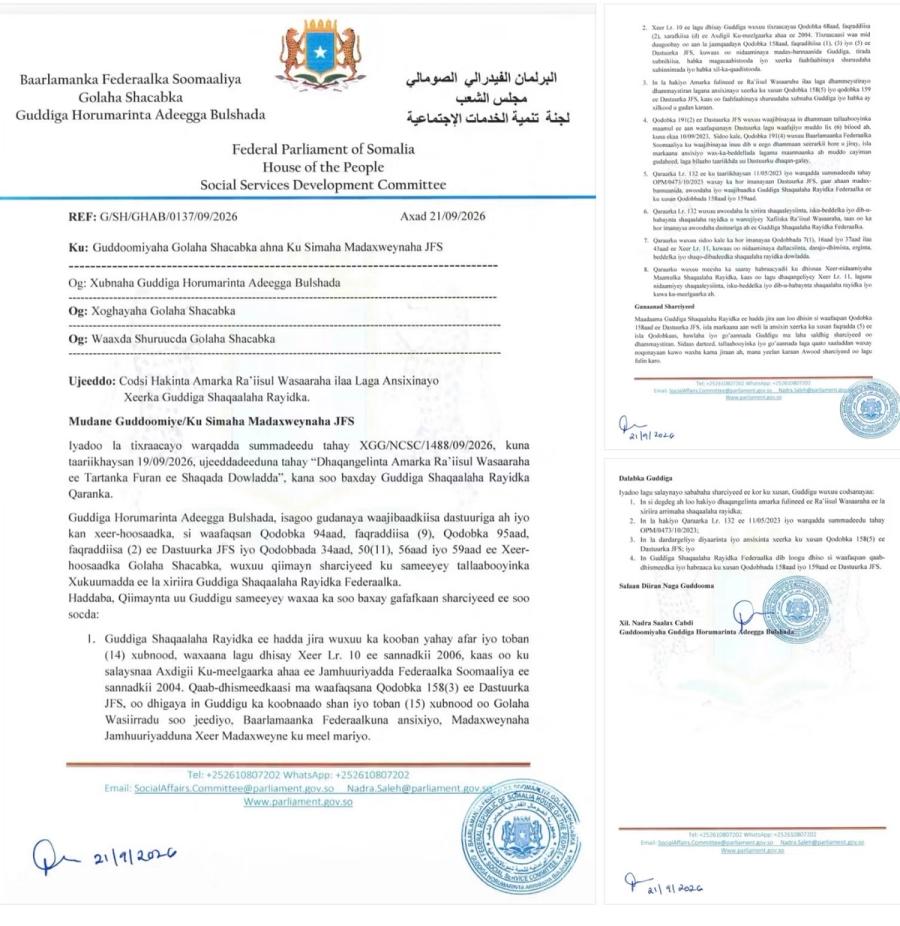
The relevant committee in the House of the People said the prime minister’s directive could not be implemented in its current form, arguing that the government must first establish and clarify the legal procedures governing the recruitment and appointment of senior civil servants.
According to the committee, the decision requires a clear legal foundation before ministries and state agencies begin advertising, assessing or appointing candidates through the proposed system.
The Chairperson of the House of the People’s Social Services Development Committee also opposed the directive, saying the recruitment process for government positions must follow established legal and institutional procedures.
The committee’s position places parliament at odds with the Prime Minister’s Office over a reform programme that affects senior posts across federal agencies and ministries.
The dispute is not only about whether senior officials should be selected through competitive recruitment. It also concerns which institution has the authority to set the rules, supervise implementation and determine whether the proposed process complies with Somalia’s existing civil-service laws and regulations.
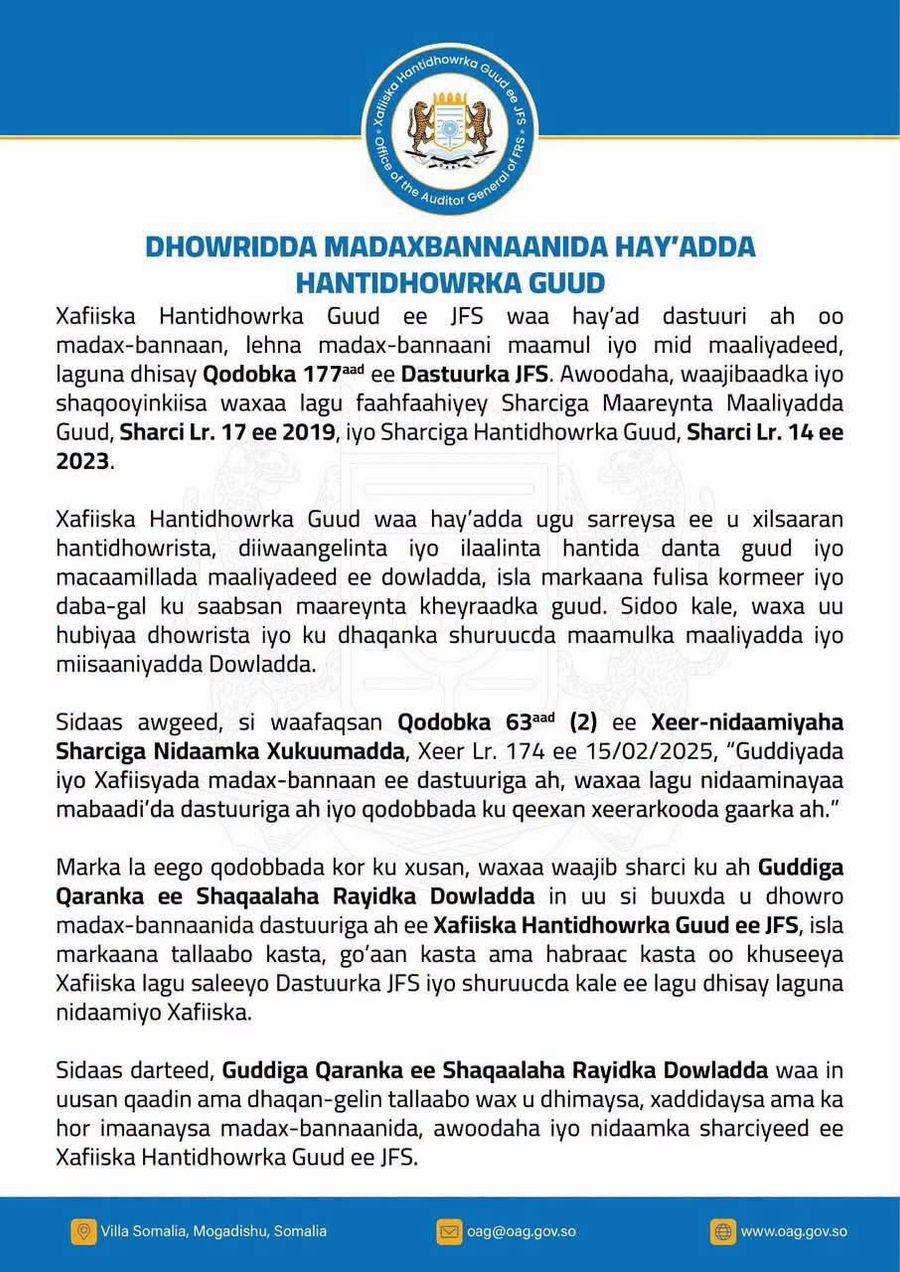
Somalia’s Auditor General has separately objected to the directive, which calls for open competition for departmental director positions in government institutions.
The Auditor General’s intervention has added weight to concerns over the legal and administrative basis of the order. The office is responsible for oversight of public resources and government financial accountability, making its objections significant in a dispute involving senior state positions and the administration of public institutions.
Neither the Prime Minister’s Office nor the ministries directly affected by the proposed restructuring had publicly responded to the objections at the time of publication.
Legal and Institutional Dispute
The disagreement has exposed wider institutional tensions over how Somalia’s federal government should manage its civil-service workforce.
Government employment has long been an important political and administrative issue in Somalia, where efforts to build professional state institutions have been complicated by limited capacity, competing political interests and disputes over the distribution of public positions.
Supporters of open recruitment generally argue that competitive processes can improve transparency, reduce patronage and ensure that qualified candidates are selected for senior roles. However, parliamentary concerns suggest that the current dispute is focused on the procedure and legal authority behind the directive rather than solely on the principle of competitive recruitment.
The House of the People committee said the government must clarify the legal framework before the process moves forward. That could require consultation with parliament, relevant ministries, civil-service bodies and legal institutions before a final recruitment procedure is approved.
The committee’s rejection of the directive in its current form means that implementation could be delayed unless the executive and parliament reach agreement on the process.
It remains unclear whether the Prime Minister’s Office will revise the directive, seek legal clarification, engage the committee in further discussions or press ahead with the proposed recruitment plan.
Concerns Over Political Influence
The civil-service restructuring programme has reportedly triggered disagreements among senior officials and ministries, particularly institutions that oversee development projects and major government programmes.
Independent sources familiar with the matter say some ministers view the restructuring as an opportunity to influence appointments to positions that are important for managing projects, budgets and government services.
Critics of the programme allege that some ministers close to President Hassan Sheikh Mohamud want to secure positions for their supporters through the restructuring process. Those allegations could not be independently verified, and no evidence has been made public showing that any appointments have been allocated to political allies.
The concerns reflect a broader fear among some officials that a reform intended to professionalise the civil service could itself become a source of political competition if the process is not clearly regulated and independently supervised.
Several ministries with major projects are reported to have become focal points of the dispute. Ministers are said to be increasingly concerned about changes that could reduce their influence over staff, departments and project implementation.
There is no public indication that the government has made final appointments under the contested directive. The current dispute is therefore centred on the legality and design of the recruitment system before it is fully carried out.
The absence of a clear public response from the Prime Minister’s Office has left questions about the next stage of the process, including whether the government will pause the directive while legal and parliamentary concerns are addressed.
Government Reform Agenda
The dispute comes as Somalia continues efforts to strengthen public institutions, improve governance and build a more professional civil service.
The federal government has repeatedly faced pressure from lawmakers, oversight bodies, civil-society groups and international partners to make public recruitment more transparent and ensure that government institutions are staffed according to professional standards.
Open competition for senior government positions is often presented as a key element of civil-service reform. Such a system can involve publicly advertised vacancies, eligibility requirements, written or oral assessments, interviews and independent review panels.
However, the credibility of any recruitment process depends on clear rules, public confidence and effective oversight. In Somalia’s case, parliamentary and Auditor General objections point to concerns that the process must be grounded in law and protected from political interference.
The debate also comes at a time when federal institutions are seeking to improve service delivery, implement development projects and manage limited public resources effectively.
Departmental directors hold influential positions within ministries and government agencies. They often oversee technical departments, manage staff, supervise programmes and play a role in implementing government policy.
As a result, changes to the way such officials are recruited can have a direct impact on how ministries function and how public programmes are delivered.
Somalia has spent years rebuilding its public institutions after decades of conflict, state collapse and political instability. Progress has been made in establishing federal ministries, government agencies and oversight institutions, but state capacity remains uneven.
Civil-service reform has been a central part of wider efforts to improve governance and public administration. The objective has generally been to create a workforce selected on merit, paid through formal systems and capable of delivering services without undue political influence.
Yet such reforms often create tension because they affect access to government employment, institutional authority and control over public resources.
In Somalia, debates over appointments can become especially sensitive when they involve influential ministries, donor-supported projects or positions connected to public finances and administration.
The current disagreement highlights the challenge of balancing executive reform initiatives with parliamentary oversight and legal accountability.
It also underlines the importance of defining the role of the Prime Minister’s Office, parliament, the Auditor General, civil-service institutions and individual ministries in decisions affecting senior government employment.
The dispute is significant because it concerns the rules governing senior public-sector employment in Somalia. Departmental directors influence how ministries operate, how projects are managed and how public services are delivered.
The objections from both a parliamentary committee and the Auditor General increase pressure on the government to demonstrate that any civil-service restructuring follows the law and includes credible safeguards against favoritism.