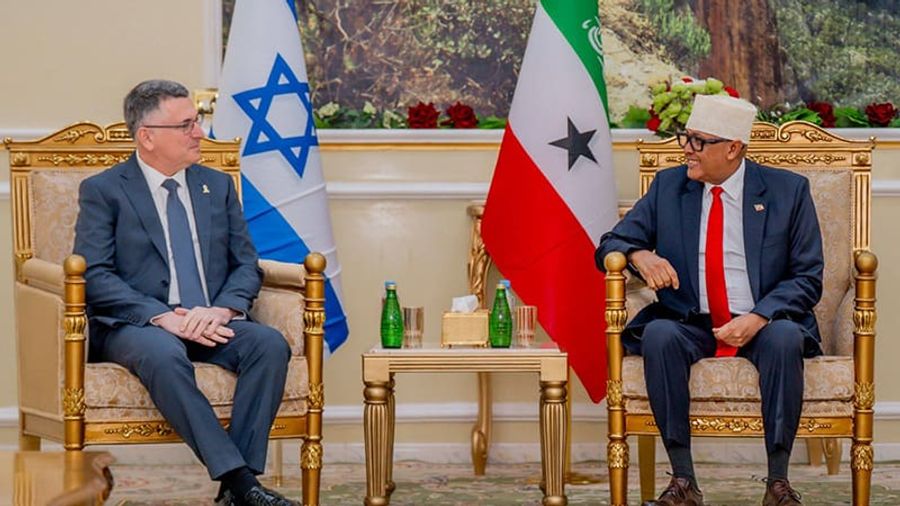
Saturday, June 13, 2026 (Baidoa Online) -President Hassan Sheikh Mohamud has warned that Somaliland faces significant political and diplomatic challenges and is unlikely to achieve international recognition in the foreseeable future, amid renewed tensions between the Federal Government of Somalia and the self-declared republic.
Political tensions between Somalia’s Federal Government and Somaliland have intensified following renewed diplomatic activity involving regional and international partners, alongside long-standing disputes over sovereignty, territorial control, and recognition.
President Hassan Sheikh Mohamud, speaking to Dawan TV, reiterated that Somaliland faces major obstacles to international recognition. He said the Federal Government is considering a range of policy options in addressing the status of Somaliland, including continued dialogue and what he described as a potential military approach aimed at preserving Somalia’s territorial integrity.
Somaliland’s expanding foreign engagement
The remarks come amid growing attention on Somaliland’s external diplomatic outreach. Reports in regional and international media have suggested that Somaliland has been strengthening informal ties with several countries, including discussions around trade, security cooperation, and strategic partnerships.
Among the most notable developments is Somaliland’s reported engagement with Israel. While formal diplomatic recognition has been announced by Israel government , media reports and diplomatic sources have indicated that both sides have explored areas of cooperation, particularly in security, intelligence-sharing interests, and regional stability in the Horn of Africa and Red Sea corridor.
Somaliland officials have previously stated that they are pursuing an independent foreign policy aimed at securing international partnerships, even in the absence of formal recognition. The Federal Government in Mogadishu maintains that such engagements violate Somalia’s sovereignty.
Ethiopia MoU and Red Sea access debate
Tensions have also been shaped by a controversial memorandum of understanding (MoU) signed in early 2024 between Ethiopia and Somaliland. The agreement reportedly explores the possibility of Ethiopia gaining access to the Red Sea through Somaliland’s coastline in exchange for potential political and economic considerations.
The deal sparked strong opposition from the Federal Government of Somalia, which described it as a breach of sovereignty and an infringement on its territorial integrity. Somalia subsequently sought international support against the agreement, while Ethiopia and Somaliland have defended it as a mutually beneficial economic arrangement.
Analysts say the MoU has significantly shifted regional dynamics, intensifying competition over access to strategic maritime routes in the Horn of Africa.
Internal conflict: SSC-Khaatumo and territorial disputes
Internal tensions within Somaliland have further complicated the political landscape, particularly in the eastern regions of Sool, Sanaag, and Cayn (SSC). Clashes in Las Anod and surrounding areas in 2023 escalated into a major conflict between Somaliland forces and local militias, resulting in significant displacement and casualties.
Following the unrest, the SSC-Khaatumo administration declared alignment with the Federal Government of Somalia, which subsequently recognized SSC-Khaatumo as part of its federal member-state framework. Somaliland, however, continues to claim the region as part of its territory, maintaining that it remains within its administrative boundaries.
The situation has remained volatile, with intermittent tensions and competing governance claims in the region.
Longstanding Somalia–Somaliland dispute
Somaliland declared independence from Somalia in 1991 following the collapse of the central government. Since then, it has operated with its own political institutions, security forces, and currency, while continuing to seek international recognition as a sovereign state.
Despite relative stability compared to southern Somalia, Somaliland remains unrecognized by any UN member state. The Federal Government of Somalia continues to assert that the country remains a single, indivisible state, making political reconciliation a central point of contention.
Repeated dialogue efforts facilitated by international partners over the years have failed to produce a lasting agreement, with disagreements over sovereignty, power-sharing, and constitutional status remaining unresolved.
Growing geopolitical stakes
The Horn of Africa has increasingly become a focal point for geopolitical competition, particularly due to its proximity to key maritime routes linking the Red Sea and the Gulf of Aden. Regional powers and external actors have expanded engagement in Somalia, Ethiopia, and Somaliland, contributing to a complex diplomatic environment.
Observers say Somaliland’s growing international outreach, Ethiopia’s strategic maritime interests, and Somalia’s insistence on territorial unity have collectively raised tensions, making the dispute more internationalized than at any point in recent years.
With parallel diplomatic initiatives, contested regional agreements, and unresolved internal conflicts, the Somalia–Somaliland dispute remains deeply entrenched. Analysts warn that without renewed structured dialogue and broader regional consensus, the current trajectory could further heighten political friction in the Horn of Africa.