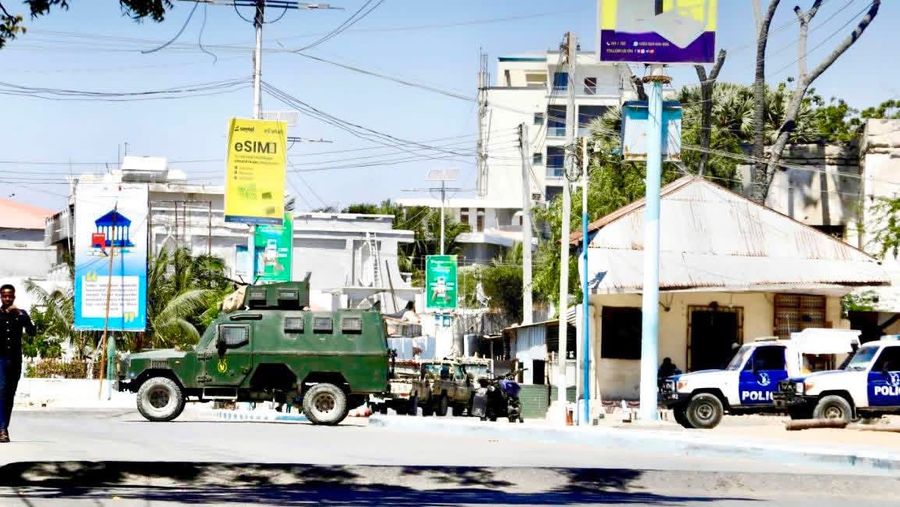
MOGADISHU, Somalia — August 24, 2026 — Somalia is confronting a convergence of political, security, constitutional, humanitarian and economic pressures that could weaken the country’s institutions and reverse years of internationally supported state-building.
President Hassan Sheikh Mohamud’s administration faces an unresolved election dispute, strained relations with several federal member states, an emboldened Al-Shabaab insurgency and growing questions about the future of the African Union Support and Stabilization Mission in Somalia, or AUSSOM.
At the same time, allegations of government-linked land seizures, recurrent clan violence, collapsing humanitarian assistance and renewed piracy are adding to public anxiety.
Not every crisis originated under the current administration. Somalia’s federal disputes, insurgency, clan conflicts and weak institutions have developed over decades. However, critics argue that the government’s political decisions have aggravated several existing fault lines. The administration rejects accusations that it is dismantling federalism or seeking to retain power unlawfully.
Here are 13 major issues shaping Somalia’s current crisis.
1. What caused the Baidoa crisis?
The confrontation in Baidoa grew from disagreements over elections, constitutional amendments and the division of power between the federal government and South West State.
South West State suspended cooperation with Mogadishu in March, accusing federal authorities of interfering in its political affairs. Federal forces subsequently entered Baidoa, and regional President Abdiaziz Hassan Mohamed Laftagareen resigned after his disputed re-election.
More than 50,000 people were displaced during the March escalation, while humanitarian organisations temporarily suspended some operations. Fighting returned in August when forces linked to Laftagareen attacked federal positions. Government troops repelled the assault, but combatants and civilians were killed.
The government described its intervention as necessary to restore constitutional order. Its opponents characterised it as a federal attempt to remove an elected regional administration and control Baidoa’s political transition.
The dispute illustrates a wider national problem: Somalia still lacks an accepted mechanism for resolving conflicts between Mogadishu and federal member states.
2. Why do land disputes continue to destabilise Mogadishu?
Allegations involving the seizure and sale of public and privately claimed land have become a significant source of public anger in Mogadishu.
Affected families, opposition politicians, religious scholars and former national leaders have called for investigations into demolitions, forced evictions and transfers of government property. Some residents allege that officials and politically connected businesspeople have used state security forces to remove occupants without transparent judicial proceedings.
A 2026 country assessment by the BTI Transformation Index said political and military elites have regularly been implicated in taking public and private property. It identified government land grabs and forced evictions as major sources of tension in the capital.
Somalia’s government has defended some demolitions as lawful recovery of public property. The absence of a reliable land registry, conflicting documents and a weak court system make it difficult to determine ownership. These institutional weaknesses also create opportunities for fraud and political abuse.
3. Can Somalia break its election and constitutional deadlock?
Somalia’s political actors remain divided over the election model, constitutional amendments and the duration of the president’s mandate.
The government says its reforms are intended to replace indirect, clan-based selection with direct elections and strengthen political accountability. Puntland, Jubaland and opposition leaders argue that fundamental constitutional and electoral changes cannot be implemented without a national agreement.
The dispute intensified after the government maintained that constitutional amendments had changed the presidential term from four to five years. Opposition groups rejected that interpretation and questioned President Mohamud’s legitimacy after May 15, 2026.
The crisis is therefore no longer limited to election procedures. It concerns which constitutional text is binding, when national elections must occur and whether changes adopted without Puntland and Jubaland can legitimately be enforced nationwide.
4. Why are Puntland and Jubaland deadlocked with Mogadishu?
Puntland withdrew recognition from federal institutions in 2024 following constitutional amendments approved in Mogadishu. It said it would operate independently until an inclusive constitutional settlement was reached.
Jubaland’s dispute with the federal government has involved the legitimacy of President Ahmed Madobe’s election, control of security forces and administration of the Gedo region. Mogadishu rejected Madobe’s re-election, while Jubaland accused the federal government of attempting to remove its leadership.
These disagreements have divided security forces and redirected political attention away from Al-Shabaab. They have also prevented the National Consultative Council from functioning as a genuinely national forum because two of the most influential federal states remain outside the process.
5. Can AUSSOM survive its funding crisis?
AUSSOM began operations in January 2025, succeeding the African Union Transition Mission in Somalia. Its mandate is to assist Somali forces, protect strategic infrastructure and support operations against Al-Shabaab.
The mission has never received a predictable financing arrangement. A report presented to the United Nations identified a funding gap of approximately $38.5 million against a 2025 budget of $154.7 million. Analysts subsequently warned that no adequate funding had been pledged for 2026.
Without reliable financing, troop-contributing countries may struggle to pay allowances, maintain equipment or sustain deployments. A weakened mission could force premature withdrawals from forward bases before Somali forces are ready to replace them.
6. Is the United States abandoning AUSSOM?
The United States has not announced a boycott of AUSSOM itself. Its stated position is more specific—and potentially just as consequential.
Washington informed the African Union that it would not block the renewal of AUSSOM’s mandate at the end of 2026. However, it said it would oppose continued United Nations logistical and operational support through UNSOS.
UN support supplies food, fuel, transportation, medical evacuation and other essential services to nearly 12,000 African Union personnel. Diplomatic sources told Reuters that AUSSOM could become unviable without that logistical system.
The United States cited Somalia’s political infighting, limited security-sector reform and failure to sustain territorial gains. Washington has reportedly contributed roughly $2 billion to the UN support structure over the years.
7. Is the federal government trying to impose its agenda by force?
Opposition groups and regional leaders accuse the administration of using federal security forces to impose political outcomes. They point to military confrontations in Baidoa, Jubaland and Mogadishu as evidence.
The federal government disputes that interpretation. It says national forces are enforcing constitutional authority, protecting state institutions and responding to armed groups challenging the government.
Nevertheless, using soldiers trained to fight Al-Shabaab in political disputes carries considerable risks. It can fragment the security services along political or clan lines, weaken public confidence and divert personnel and equipment from counterinsurgency operations.
Somalia’s unfinished constitutional settlement makes the distinction between lawful federal intervention and political coercion especially contested.
8. Is Al-Shabaab preparing to capture Mogadishu?
There is no conclusive public evidence that Al-Shabaab is preparing for an immediate conventional takeover of Mogadishu.
However, the movement has regained territory, expanded attacks and demonstrated an ability to infiltrate areas close to the capital. The International Crisis Group reported that Al-Shabaab’s 2025 advances erased many government gains achieved two years earlier.
The organisation can also exert influence without physically occupying Mogadishu. It collects taxes from businesses, conducts assassinations, attacks government installations and uses intimidation to undermine public confidence.
Analysts have assessed that a direct assault to seize the capital remains unlikely in the short term. The more credible danger is gradual encirclement, disruption of supply routes and institutional weakening if political fragmentation and funding shortages continue.
9. Has the government’s war against Al-Shabaab failed?
The campaign has stalled and suffered serious reversals, although describing it as a total failure ignores gains made by Somali forces and allied local fighters.
The first phase of the offensive, launched in 2022, removed Al-Shabaab from several communities in central Somalia. But weak local administration, unreliable troop supply lines and divisions among clan forces made many captured areas difficult to hold.
Al-Shabaab later recaptured strategic territory and intensified attacks. The conflict has consequently returned to a military stalemate: the government controls major cities, while the insurgents retain extensive rural influence and the capacity to strike heavily protected targets.
The central lesson is that clearing territory without establishing permanent security, justice and local administration does not produce lasting control.
10. How is donor fatigue affecting ordinary Somalis?
Donor fatigue has moved from a diplomatic concern to a direct humanitarian threat.
The World Food Programme reported in August that six million Somalis were experiencing acute food insecurity while the agency had only about one-tenth of the financial resources available during the 2022 hunger emergency.
Nearly 1.9 million children are projected to experience acute malnutrition in 2026. Funding reductions have already contributed to the closure of 205 health and nutrition centres, with hundreds more at risk.
The decline reflects competing global emergencies, changing donor priorities and dissatisfaction with Somalia’s limited political and security progress. For vulnerable families, however, it means longer journeys for treatment and a greater risk of preventable deaths.
11. Are foreign rivalries turning Somalia into a geopolitical battleground?
Somalia and the surrounding Horn of Africa have become increasingly important to the UAE, Saudi Arabia, Egypt, Ethiopia, Kenya, Turkey and Israel.
Their interests include ports, Red Sea shipping routes, military access, counterterrorism, trade and diplomatic influence. Ethiopia seeks dependable access to the sea, while Egypt views the region partly through its Nile dispute with Ethiopia. The UAE has developed relationships with Somaliland and Puntland, while Saudi Arabia, Egypt and Turkey have reinforced relations with Mogadishu.
Israel’s December 2025 recognition of Somaliland introduced another major fault line. Somalia, the African Union, Egypt and Turkey condemned the decision as a violation of Somali sovereignty.
Kenya maintains economic and security interests in Jubaland and shares a long border with Somalia. These overlapping relationships give Somali actors useful foreign partnerships, but they can also deepen internal divisions when external governments support competing national or regional authorities.
12. Why is clan fighting increasing?
Competition over land, water, political positions and control of local administrations continues to fuel inter-clan violence.
The European Union Agency for Asylum recorded more than 1,200 deaths connected to clan conflicts in Gedo, Bay and Mudug between April 2023 and March 2025. Human Rights Watch also documented recurring violence in Gedo’s Luuq district and the Hiraan region.
Government distribution of weapons to clan militias for the campaign against Al-Shabaab has introduced an additional danger. Arms initially supplied for counterinsurgency operations can later be used in local disputes.
These conflicts displace civilians, disrupt trade and create openings for Al-Shabaab to recruit fighters, impose settlements or present itself as an alternative source of justice.
13. Why has Somali piracy returned?
Piracy has re-emerged as a major maritime security concern after years of reduced activity.
Three vessels were hijacked within one week in April 2026, and further seizures followed. In August, pirates captured an oil tanker roughly 136 nautical miles east of Yemen, demonstrating their ability to operate far from the Somali coastline.
Security specialists link the resurgence to reduced international naval patrols, economic hardship in coastal communities, illegal fishing, weak coastal governance and the availability of profitable ransom payments.
Pirates are also using motherships, satellite communications and GPS equipment to expand their operational range. The renewed attacks threaten commercial shipping and could increase insurance and transportation costs throughout the western Indian Ocean.
Somalia’s most serious danger is not any single crisis but the interaction among all 13.
Political confrontations are dividing forces needed to fight Al-Shabaab. Security reversals are weakening donor confidence. Funding reductions are undermining AUSSOM and humanitarian operations. Clan conflicts and regional rivalries are creating additional spaces for insurgents and criminal networks.
President Mohamud’s administration can argue that it inherited many of these structural problems. It cannot, however, avoid responsibility for how it responds to them.
An inclusive agreement on elections and constitutional rules would not immediately defeat Al-Shabaab, end piracy or restore humanitarian funding. It could nevertheless rebuild cooperation between Mogadishu and the federal member states—the essential first step towards addressing Somalia’s increasingly interconnected crises.