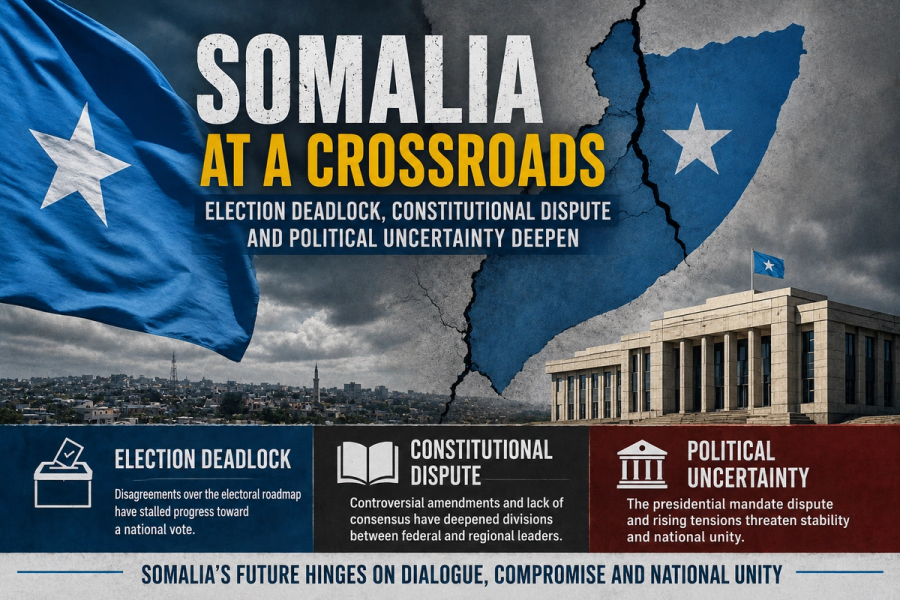
Wednesday, June 17, 2026 (Baidoa Online) -Somalia is entering a period of growing political uncertainty as disagreements over elections, constitutional reforms, and presidential legitimacy continue to dominate the national agenda. More than a month after the expiry of President Hassan Sheikh Mohamud’s original four-year mandate on May 15, 2026, the country remains divided over the future of its political transition and governance framework.
The dispute has exposed deep fractures between the Federal Government, opposition leaders, and several federal member states, raising concerns about political stability at a time when Somalia is also confronting significant security and economic challenges.
A Disputed Political Transition
At the center of the crisis is a fundamental disagreement over the country’s constitutional order and electoral roadmap.
The Federal Government maintains that constitutional amendments approved by Parliament legally extended the mandates of federal institutions and created a framework for future direct elections. Government officials argue that the reforms are necessary to move Somalia away from its longstanding indirect clan-based electoral model toward a more democratic one-person-one-vote system.
Opposition leaders, however, reject that interpretation. They contend that the constitutional changes lacked broad national consensus and argue that major decisions affecting the country’s political future should have been negotiated among all key stakeholders, including federal member states and opposition groups.
The disagreement has effectively created two competing narratives: one centered on constitutional continuity through parliamentary approval, and another focused on political legitimacy through national consensus.
Growing Tensions Between Mogadishu and Federal States
The election dispute has also widened the gap between Mogadishu and some regional administrations.
Several federal member states have expressed reservations about the constitutional process and the electoral model being pursued by the federal government. Regional leaders argue that Somalia’s federal structure requires extensive consultation before implementing major political reforms.
As a result, relations between the center and certain regional administrations have become increasingly strained, complicating efforts to reach a nationwide political agreement.
Analysts warn that prolonged disagreements could weaken cooperation on security, development, and state-building initiatives that require close coordination between federal and regional authorities.
Echoes of Previous Political Crises
Many observers see similarities between the current situation and previous electoral disputes that have periodically destabilized Somalia’s fragile political system.
The country experienced a major constitutional and electoral crisis in 2021 when delayed elections led to months of political uncertainty and security tensions in Mogadishu. While the current circumstances differ in important ways, concerns are growing that the absence of a clear political settlement could once again create institutional paralysis.
Political tensions have already manifested themselves through heated rhetoric, competing political gatherings, and disagreements over the legitimacy of state institutions.
For many Somalis, the fear is not merely a constitutional dispute but the possibility that political divisions could undermine national unity and distract from pressing security concerns.
Security Challenges Complicate the Political Landscape
The political deadlock comes at a sensitive moment for Somalia’s security sector.
Government forces and allied local militias remain engaged in ongoing military operations against Al-Shabaab across several regions of the country. While security operations continue, analysts caution that prolonged political confrontation risks diverting attention from the broader fight against insurgency.
Historically, periods of political instability have often provided opportunities for extremist groups to exploit divisions within the state.
As political leaders focus on constitutional and electoral disputes, security experts emphasize the importance of preserving national cohesion and maintaining momentum in counterinsurgency efforts.
International Concern Mounts
International partners have increasingly voiced concern over Somalia’s political trajectory.
Diplomatic missions and regional organizations have repeatedly encouraged Somali leaders to pursue dialogue and avoid actions that could deepen divisions. The international community broadly supports a Somali-led solution but has emphasized the need for consensus, inclusivity, and institutional stability.
Foreign partners also fear that prolonged uncertainty could affect economic reforms, international investment, debt-relief gains, and broader state-building efforts achieved over recent years.
The longer the political impasse continues, the greater the risk that confidence in Somalia’s institutions could be eroded both domestically and internationally.
The Constitutional Question
Perhaps the most significant issue emerging from the crisis is the unresolved question of constitutional legitimacy.
Somalia’s Provisional Constitution has long been a subject of debate, with successive governments seeking to complete and reform the document. While constitutional review is widely regarded as necessary, disagreements remain over how such reforms should be adopted and who should participate in the process.
Supporters of the recent amendments view them as a historic step toward completing Somalia’s state-building project.
Critics argue that constitutional changes affecting elections, power-sharing arrangements, and institutional mandates require a broader political settlement before implementation.
The outcome of this debate may shape Somalia’s political system for years to come.
What Lies Ahead?
Somalia now stands at a pivotal moment.
The country faces a choice between prolonged political confrontation and negotiated compromise. While neither side appears ready to fully abandon its position, pressure is mounting for a national dialogue capable of producing a mutually acceptable roadmap.
The coming months will likely determine whether Somalia can navigate its constitutional and electoral disputes through political consensus or whether divisions will deepen further.
For a nation still rebuilding after decades of conflict, the stakes could hardly be higher.