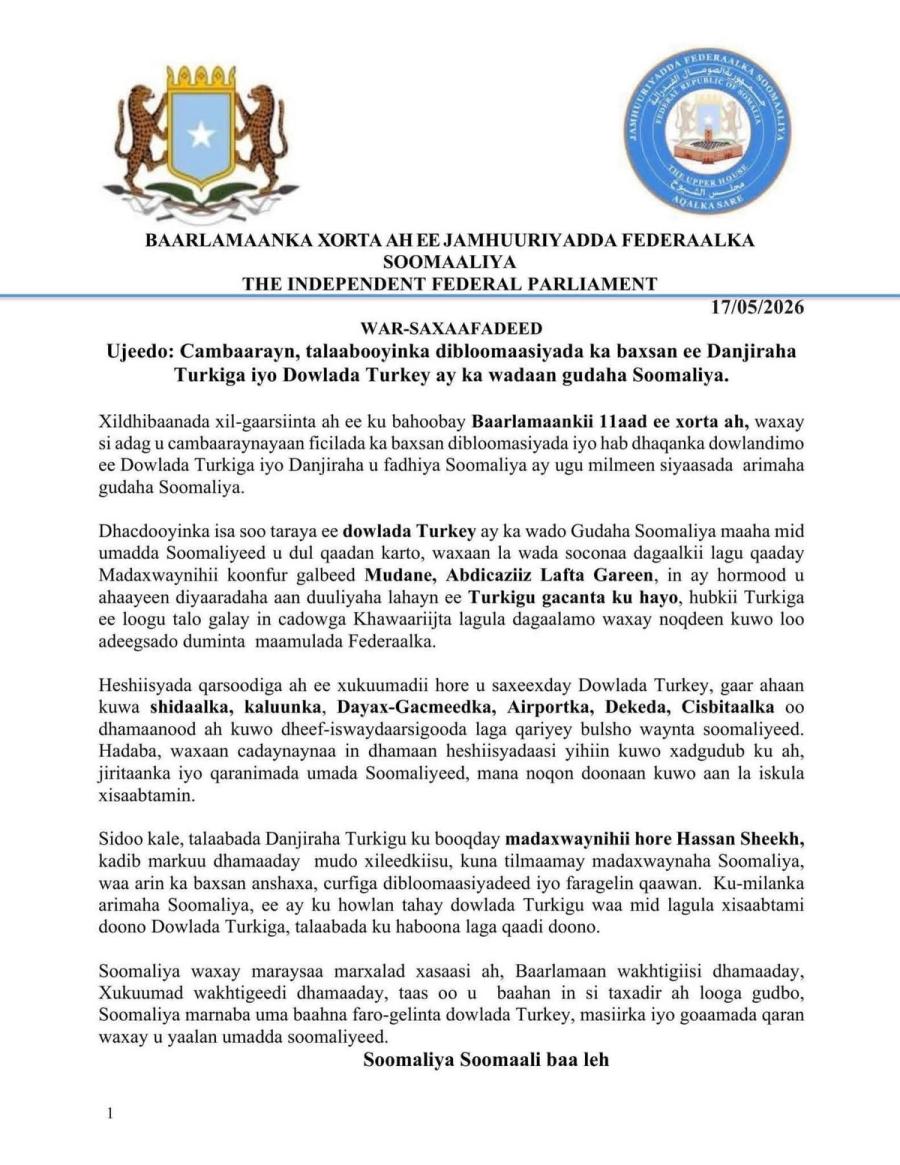
Sunday, May 16, 2026 (Baidoa Online) -Somalia’s Free Parliament has accused the Government of Turkey of interfering in the internal affairs of the Federal Government of Somalia, warning that increasing foreign influence could undermine the country’s sovereignty and constitutional governance.
In a statement issued this week, members of the Free Parliament expressed concern over what they described as Turkey’s growing political involvement in Somalia’s domestic affairs. The lawmakers said any direct influence by a foreign government on Somalia’s political institutions or leadership decisions would constitute a violation of the country’s independence and national sovereignty.
The allegations come amid ongoing political discussions in Somalia regarding governance, constitutional reforms, and the country’s future electoral framework. Turkey has not publicly responded to the accusations.
According to the statement, the parliamentarians said Somalia is a sovereign nation with full authority over its internal political processes and foreign relations. They stressed that decisions concerning governance, national policy, and constitutional matters should remain exclusively within the authority of Somali institutions.
The lawmakers acknowledged the longstanding relationship between Somalia and Turkey, describing Ankara as an important international partner that has contributed significantly to Somalia’s reconstruction efforts over the past decade.
However, they argued that international partnerships must be based on mutual respect and transparency. The statement emphasized that foreign cooperation should strengthen Somali institutions rather than create dependence or influence political decision-making.
Members of the Free Parliament called on the Federal Government of Somalia to carefully review strategic agreements and partnerships with foreign countries. They said all international arrangements should be assessed to ensure they serve the interests of the Somali people and comply with the country’s constitutional framework.
As of Wednesday, the Federal Government of Somalia had not issued an official response to the concerns raised by the Free Parliament.
Turkey has also not publicly commented on the allegations.
Ankara remains one of Somalia’s closest international partners and has played a major role in the country’s development efforts since expanding its engagement in Somalia in 2011.
Turkish support has included infrastructure projects, humanitarian assistance, healthcare services, educational programs, and security cooperation. Turkish-backed initiatives have contributed to the construction of roads, hospitals, government facilities, and training programs for Somali security forces.
Turkey also operates several development and humanitarian programs across Somalia through government institutions and aid agencies.
Growing Debate Over Foreign Influence
The accusations emerge amid broader public and political discussions regarding the role of foreign governments in Somalia’s governance and decision-making processes.
Political figures, civil society groups, and analysts have increasingly debated the extent of international involvement in Somalia’s political affairs as the country continues to navigate security challenges, constitutional reforms, and state-building efforts.
Some political actors argue that international partnerships are essential for maintaining stability and supporting development initiatives. Others have expressed concern that excessive external influence could weaken domestic institutions and reduce national ownership of political processes.
The issue has become particularly sensitive as Somalia works toward implementing governance reforms and preparing for future political transitions.
Relations between Somalia and Turkey have expanded significantly over the past fifteen years. Turkey became one of Somalia’s most visible international partners following its humanitarian response during the 2011 famine.
Since then, Turkish involvement has grown across multiple sectors, including infrastructure, education, healthcare, trade, and security cooperation. The partnership has often been cited by both governments as an example of strong bilateral relations.
At the same time, discussions regarding foreign influence have periodically surfaced in Somali politics. Similar concerns have been raised in previous years regarding the role of various international actors involved in Somalia’s political, security, and development sectors.
Somalia continues to rely heavily on international assistance while simultaneously seeking to strengthen national institutions and increase domestic control over governance processes.
The allegations raised by the Free Parliament highlight ongoing tensions between the need for international support and the desire to preserve Somalia’s political independence.
The debate could influence future discussions on foreign partnerships, security cooperation, and development agreements. It may also increase scrutiny of international actors operating within Somalia’s political and institutional landscape.
For Somalia’s leadership, balancing international cooperation with national sovereignty remains a central challenge as the country pursues long-term stability, constitutional reforms, and state-building efforts.
Whether the concerns raised by the Free Parliament lead to formal government action remains unclear. However, the issue is likely to remain part of the broader national conversation about Somalia’s future governance and relations with foreign partners.