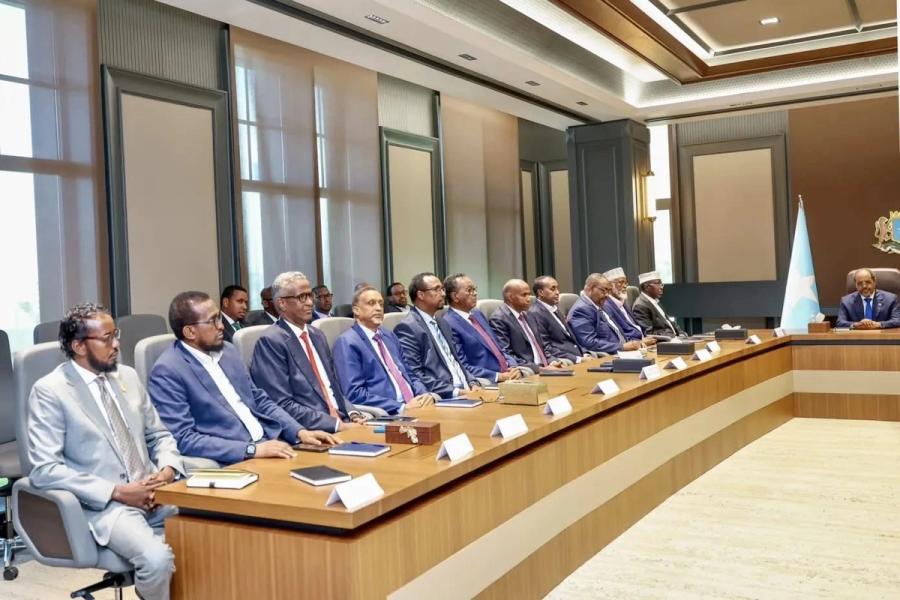
MOGADISHU — OCT,12,2026- Somalia’s Future Council has warned President Hassan Sheikh Mohamud against any military action targeting former President Sharif Sheikh Ahmed and other opposition leaders, amid mounting tensions over security deployments near their residences in the capital.
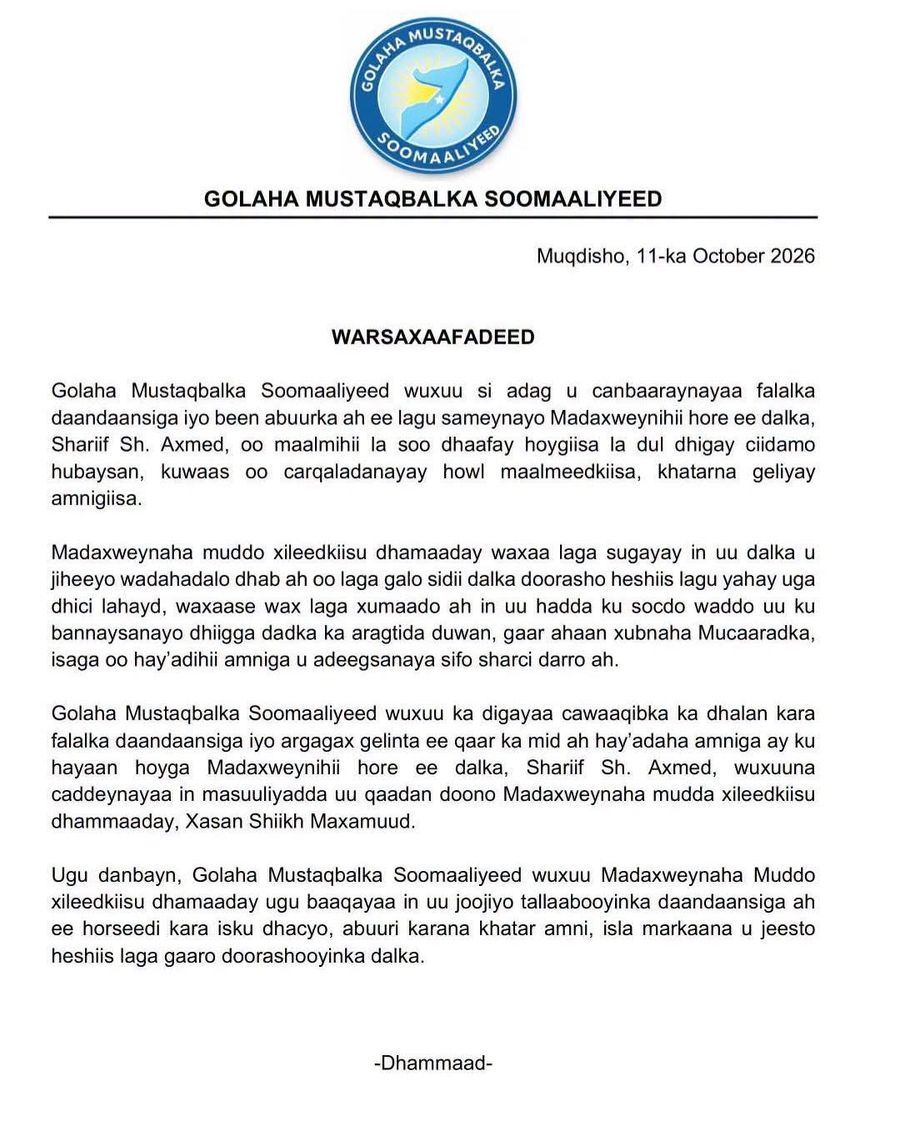
In a statement issued on October 11, the council accused the federal government of intimidating political opponents and warned that armed confrontations could endanger civilians and deepen the country’s political crisis.
The statement followed allegations by Sharif that his Mogadishu residence faced a direct threat of attack. It also came amid competing accounts from the former president’s office and the National Intelligence and Security Agency, known as NISA, over incidents involving their respective security personnel.
The council urged Mohamud to prevent an escalation and pursue negotiations over Somalia’s disputed electoral process. It said the president would bear responsibility for any consequences arising from actions against opposition leaders.
The Future Council condemned what it described as provocative deployments around the former president’s home, alleging that the presence of armed personnel had restricted his movements and threatened his safety.
It accused the administration of using state security institutions to exert political pressure and said disagreements over elections and presidential authority should be resolved through dialogue.
The council’s statement reflected growing concern among opposition figures that the confrontation could develop into fighting in residential areas of Mogadishu, where previous clashes have displaced families and damaged property.
Sharif’s office has rejected NISA’s allegations that armed men under his command attacked government security personnel. His office said members of his protection detail were personnel from Somalia’s national armed forces and disputed their portrayal as militia fighters.
The former president also alleged that roads leading to his residence had been blocked and that access to essential supplies, including food and water, had been obstructed.
He further claimed that some employees had been abducted and that armed forces had gathered near his home. Those allegations have not been independently verified.
Sharif said his guards had exercised restraint to avoid a confrontation that could put nearby residents at risk. He called for an end to measures he described as harassment and urged international partners to help prevent further escalation.
NISA presented a different account of the situation.
In its October 11 statement, the agency accused armed men it linked to Sharif of attempting to provoke clashes with its Public Protection Forces in Mogadishu’s Wadajir district.
The agency alleged that the men entered residential properties carrying assault rifles, machine guns and rocket-propelled grenades. It said its personnel had shown restraint and maintained that its security operations were lawful and unrelated to political rivalries.
NISA released footage it described as evidence supporting its allegations. The footage has not been independently authenticated, and it remains unclear whether the men shown were acting under Sharif’s orders.
The sharply conflicting accounts have increased uncertainty over the circumstances surrounding the deployments and the incidents that preceded them.
Separate reports described government forces assembling near the residences of Sharif and former Prime Minister Hassan Ali Khaire in the vicinity of Mogadishu’s airport.
Military vehicles and heavily armed units were reportedly positioned along nearby roads, raising concerns about the possibility of a confrontation between government forces and security personnel protecting opposition leaders.
The purpose and scope of those deployments remain disputed. Allegations that the government intends to launch an operation against opposition figures have not been independently established.
The latest tensions follow an earlier outbreak of violence in Mogadishu in June, when government troops and opposition allied fighters exchanged fire ahead of planned anti-government demonstrations.
That fighting damaged property and forced residents to flee affected neighbourhoods. Sharif alleged at the time that government forces had targeted his residence, while Khaire also accused the authorities of attacking opposition figures.
The June confrontation demonstrated how quickly political disputes in the capital can develop into armed clashes, particularly when rival forces operate close to residential communities.
At the centre of the wider dispute are disagreements over constitutional changes, the duration of the president’s mandate and arrangements for national elections.
Parliament approved constitutional amendments in March that potentially extended Mohamud’s presidency by a year and delayed elections. Opposition leaders have challenged the changes and rejected extending the tenure of officials elected under the previous constitutional framework.
The government has defended its constitutional and electoral reforms as steps towards introducing direct voting and strengthening state institutions.
Opposition politicians argue that major changes to the electoral system require broader political agreement. They have called for negotiations involving federal leaders, regional administrations and other political stakeholders.
The Future Council linked those unresolved disagreements to the current security tensions, warning that pressure on opposition figures could undermine efforts to reach an electoral settlement.
Its description of Mohamud as a president whose mandate had expired reflects the opposition’s position in the continuing dispute over his tenure.
The council called on the administration to end actions that could provoke violence and focus on securing an agreed electoral framework.
The presence of opposing armed personnel in densely populated areas adds to those fears, particularly following the displacement and destruction caused by the June clashes.
The latest warning leaves the government and opposition facing renewed pressure to contain the confrontation. Both NISA and Sharif’s office have said their personnel exercised restraint, while offering conflicting accounts of who is responsible for the rising tensions.