MOGADISHU, Somalia — November 8, 2026-Somalia’s political crisis has intensified after opposition figures challenged the constitutional legitimacy of President Hassan Sheikh Mohamud’s administration, following a Supreme Court ruling that rejected the extension of the president’s and parliament’s mandates.
The latest developments have widened divisions between the federal government, opposition leaders and regional political groups, raising questions about the legality of government decisions, the future of Somalia’s electoral process and the authority of the country’s highest judicial institution.
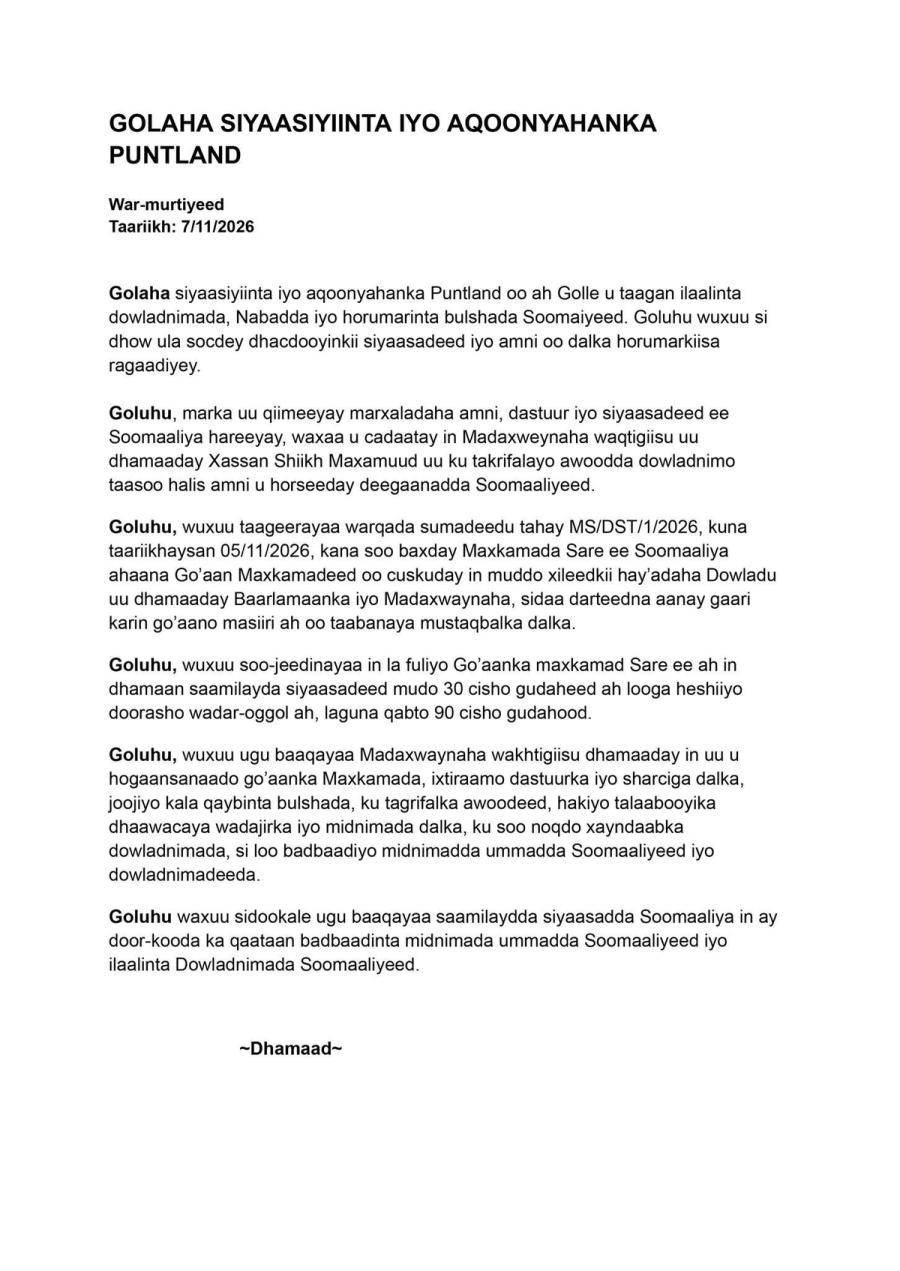
In a statement dated November 7, the Puntland Council of Politicians and Intellectuals welcomed the Supreme Court’s November 5 ruling, accusing President Hassan Sheikh Mohamud of abusing state authority and undermining constitutional governance.
The council argued that the president’s continued exercise of power after the expiration of his original constitutional mandate threatens Somalia’s political stability and national unity.
The statement comes as the opposition Somali Future Council, known locally as Golaha Mustaqbalka, continues to challenge the federal government’s position on constitutional amendments and the electoral timetable.
Opposition Challenges Legality of Government Decisions
The constitutional dispute centers on decisions made by federal institutions after their original four-year mandates expired.
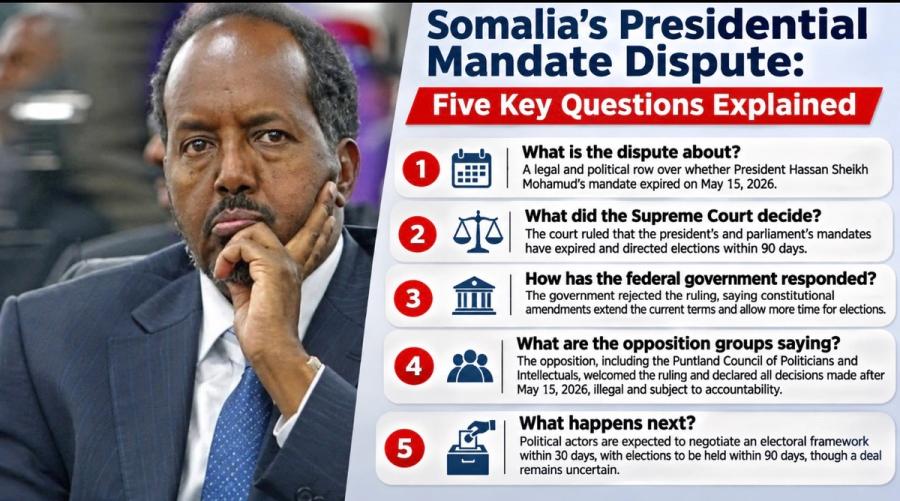
The Supreme Court’s five-judge panel ruled on November 5 that President Hassan Sheikh Mohamud’s mandate expired on May 15, 2026, while the mandates of both houses of the Federal Parliament and the government ended on April 14, 2026.
The judges determined that constitutional amendments extending presidential and parliamentary terms from four to five years could not automatically extend the mandates of officials already serving in office.
The court also declared decisions taken by those institutions under their constitutional and legal powers after the relevant expiration dates invalid.
Opposition figures have interpreted the ruling as grounds for rejecting agreements, laws and political decisions adopted by the administration after May 15.
Supreme Court Orders Elections Within 90 Days
The Supreme Court directed Somalia’s political stakeholders to reach an agreement on an electoral framework within 30 days and organize elections within 90 days.
The ruling also limited the federal government’s caretaker authority to routine administrative responsibilities, restricting decisions that exceed ordinary government operations.
The Puntland Council of Politicians and Intellectuals welcomed those directions and urged political actors to cooperate in implementing them.
In its statement, the council called on President Hassan Sheikh Mohamud to respect the judicial decision, uphold constitutional principles and refrain from actions that could deepen political divisions.
The council also appealed to Somali political stakeholders to prioritize national unity, constitutional governance and the protection of state institutions.
The 90-day election deadline directly conflicts with the federal electoral commission’s previously announced timetable, which schedules parliamentary elections for April 15, 2027, and the presidential election for May 15, 2027.
This disagreement has become a central issue in Somalia’s ongoing constitutional confrontation.
Federal Government Rejects Court’s Position
The federal government has challenged the Supreme Court ruling.
Somalia’s attorney general rejected the judgment, arguing that it had no legal effect, reflecting the administration’s opposition to the court’s interpretation of the constitutional amendments.
The presidency has maintained that constitutional changes approved earlier in 2026 provide a legal basis for extending the current institutional terms and preparing for nationwide direct elections.
The government argues that the revised electoral framework is intended to move Somalia away from its longstanding indirect electoral system toward universal suffrage.
Opposition groups and some federal member states, including Puntland and Jubaland, have disputed the constitutional process, arguing that changes affecting national governance require broader political consultation and agreement.
The conflicting positions have left Somalia facing competing interpretations of presidential authority, constitutional continuity and the appropriate electoral transition.
Judicial Independence Becomes Another Flashpoint
The constitutional dispute intensified further after President Hassan Sheikh Mohamud announced the dismissal of Supreme Court Chief Justice Baashe Yusuf Ahmed on November 4, shortly before the court delivered its ruling.
The presidency appointed former Chief Justice Ibrahim Idle Suleiman as his replacement, citing concerns about judicial administration.
However, the Supreme Court rejected the dismissal, maintaining that the president lacked the constitutional authority to remove the chief justice through that procedure.
Opposition leaders condemned the move as interference with judicial independence.
Former President Sharif Sheikh Ahmed, whose constitutional challenge contributed to the court proceedings, publicly supported the judicial ruling and criticized attempts to undermine the judiciary.
The confrontation has brought the relationship between Somalia’s executive and judicial branches under intense scrutiny.
Puntland Politicians Warn of National Instability
In their November 7 statement, Puntland politicians and intellectuals warned that continued disputes over constitutional authority could threaten national security, political stability and Somalia’s federal system.
The council urged the president to abandon actions it described as abuses of authority and to respect the separation of powers.
It also called on political stakeholders to protect Somalia’s unity and prevent disagreements from further weakening state institutions.
These warnings come as Somalia continues to confront security challenges, including the persistent threat posed by Al-Shabaab and disagreements between the federal government and some regional administrations.
Political uncertainty could complicate cooperation among institutions responsible for national security and public administration.
Foreign Support and Political Concerns
Some opposition commentary has also accused the federal government of relying on foreign political backing to sustain its position during the constitutional dispute.
However, the Puntland council’s November 7 statement does not identify foreign governments or provide evidence supporting allegations of external involvement in efforts to extend the president’s tenure.
Such allegations therefore remain separate from the documented findings of the Supreme Court and the council’s formal demands.
The broader political disagreement concerns whether Somalia’s existing leadership can continue exercising authority under the revised Constitution or must comply with the shorter electoral timetable ordered by the court.
Somalia Faces an Uncertain Political Transition
The immediate challenge facing Somalia is whether federal authorities, opposition leaders and regional stakeholders can reach a political agreement capable of resolving the competing constitutional claims.
The Supreme Court’s decision has strengthened the legal arguments advanced by opposition figures, but the federal government’s rejection of the ruling has left its implementation uncertain.
The Puntland council has called for dialogue, respect for judicial institutions and a peaceful electoral settlement.
With the court’s deadlines approaching and the government’s existing electoral timetable extending into 2027, Somalia faces a consequential dispute over constitutional authority and the organization of its next national elections.