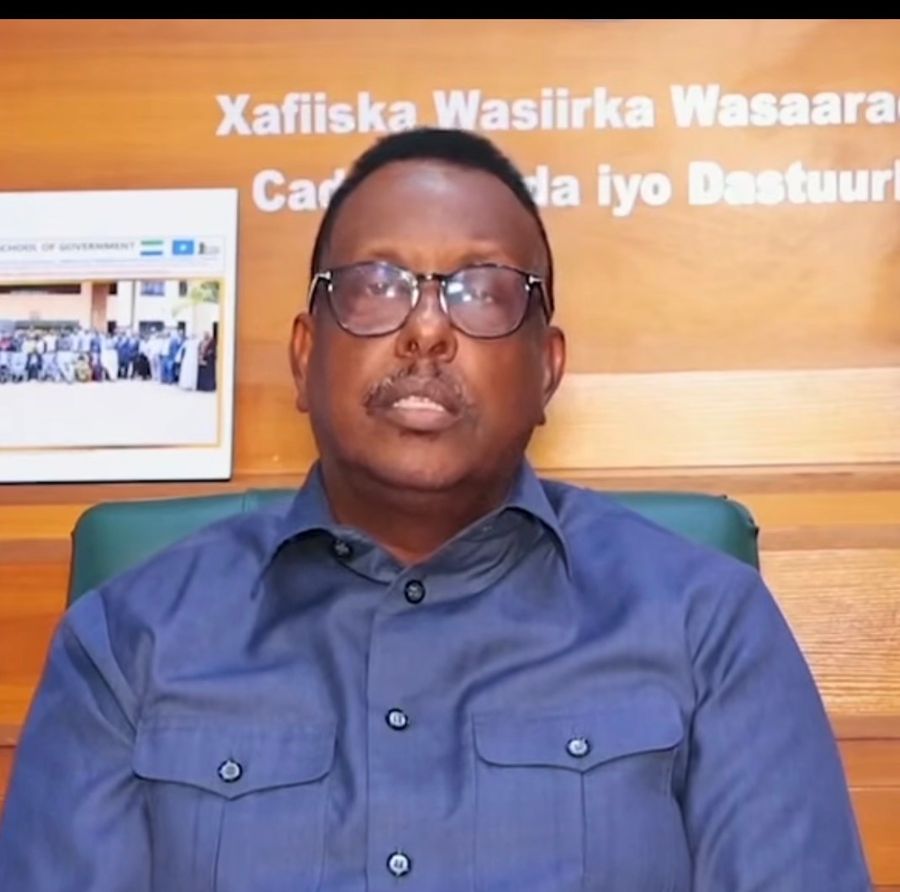
MOGADISHU, Somalia — August 26, 2026 — Somalia’s federal government has taken over justice and corrections responsibilities previously supported by the United Nations Transitional Assistance Mission in Somalia, or UNTMIS, Justice and Constitutional Affairs Minister Hassan Moallin Mohamud said, describing the handover as a step toward greater national ownership.
Mohamud said the transfer was completed on August 24 following a joint workshop in Mogadishu marking the conclusion of UNTMIS assistance to Somalia’s justice and corrections institutions.
The minister said the government had developed the institutional capacity needed to manage the responsibilities, calling the transition evidence of Somalia’s progress toward self-reliance.
The event brought together representatives of the Federal Government, federal member states, the United Nations, justice and corrections institutions, and international partners involved in supporting Somalia’s rule-of-law sector.
Mohamud thanked UNTMIS, the wider United Nations system and international partners for their contributions to institutional development, professional training and efforts to strengthen Somalia’s justice system.
He said the skills and institutional experience developed during years of international assistance would provide a foundation for continued reforms under Somali leadership.
The handover announced this week specifically concerns UNTMIS support for justice and corrections. The mission’s broader political transition remains underway and is expected to conclude by the end of October.
UNTMIS Transition
UNTMIS was established on November 1, 2024, replacing the United Nations Assistance Mission in Somalia, known as UNSOM. The UN Security Council created the transitional mission after the Somali government requested a gradual transfer of UN political-mission responsibilities to Somali institutions and the UN Country Team.
UNSOM had operated in Somalia since 2013, supporting federal and regional authorities in state-building, political dialogue, peacebuilding, reconciliation, human rights, rule-of-law reform and security-sector development.
Under the approved transition plan, UNTMIS was given a two-year mandate to progressively transfer those responsibilities. The process was divided into phases to allow Somali institutions, UN agencies and other partners to assume the mission’s remaining functions.
The UN Security Council has directed UNTMIS to complete the transition and cease operations by October 31, 2026.
The closure of the justice and corrections programme is therefore one component of a wider withdrawal process, rather than the immediate termination of every UNTMIS function in Somalia.
Government Assumes Greater Responsibility
The government says the transfer reflects increasing national capacity and ownership of public institutions. Somali officials have repeatedly argued that political, judicial and security responsibilities should gradually move from international missions to national authorities.
Justice-sector assistance provided through UNSOM and UNTMIS included institutional capacity-building, rule-of-law programmes and support for corrections services. The missions also advised Somali authorities on human rights standards and the development of accountable public institutions.
Farhan Jimale, commissioner of Somalia’s National Independent Human Rights Commission, called for stronger national ownership, independent oversight and cooperation among institutions as the transition proceeds.
Jimale said justice and corrections should be treated as human-rights issues, stressing that people held in detention retain their dignity and fundamental rights.
The end of UNTMIS marks a major change in the United Nations’ political presence in Somalia.
UN political missions have supported successive Somali administrations through years of conflict, fragile institutions and disputes over the country’s federal system. Their work has included technical advice on elections, constitutional development, reconciliation and coordination between the Federal Government and federal member states.
Somalia continues to face serious institutional and security challenges, including an Al-Shabaab insurgency, political disagreements between federal and regional leaders, limited government services and weaknesses in the judicial system.
Other UN agencies, funds and programmes will remain active after UNTMIS closes. The end of the political mission does not amount to a complete United Nations withdrawal from Somalia or the termination of humanitarian and development assistance.
Federal institutions are expected to continue absorbing the remaining responsibilities during the final phase of the UNTMIS transition.
The government will face the task of maintaining programmes previously supported by the mission, retaining trained personnel and ensuring that justice and corrections institutions receive adequate funding.
Somali authorities and the United Nations are also expected to assess outstanding responsibilities before UNTMIS formally ends its operations on October 31.
The justice-sector handover is a test of whether Somali institutions can sustain reforms after direct assistance from the UN political mission ends. Its success will depend on government funding, trained personnel, institutional cooperation and effective oversight.