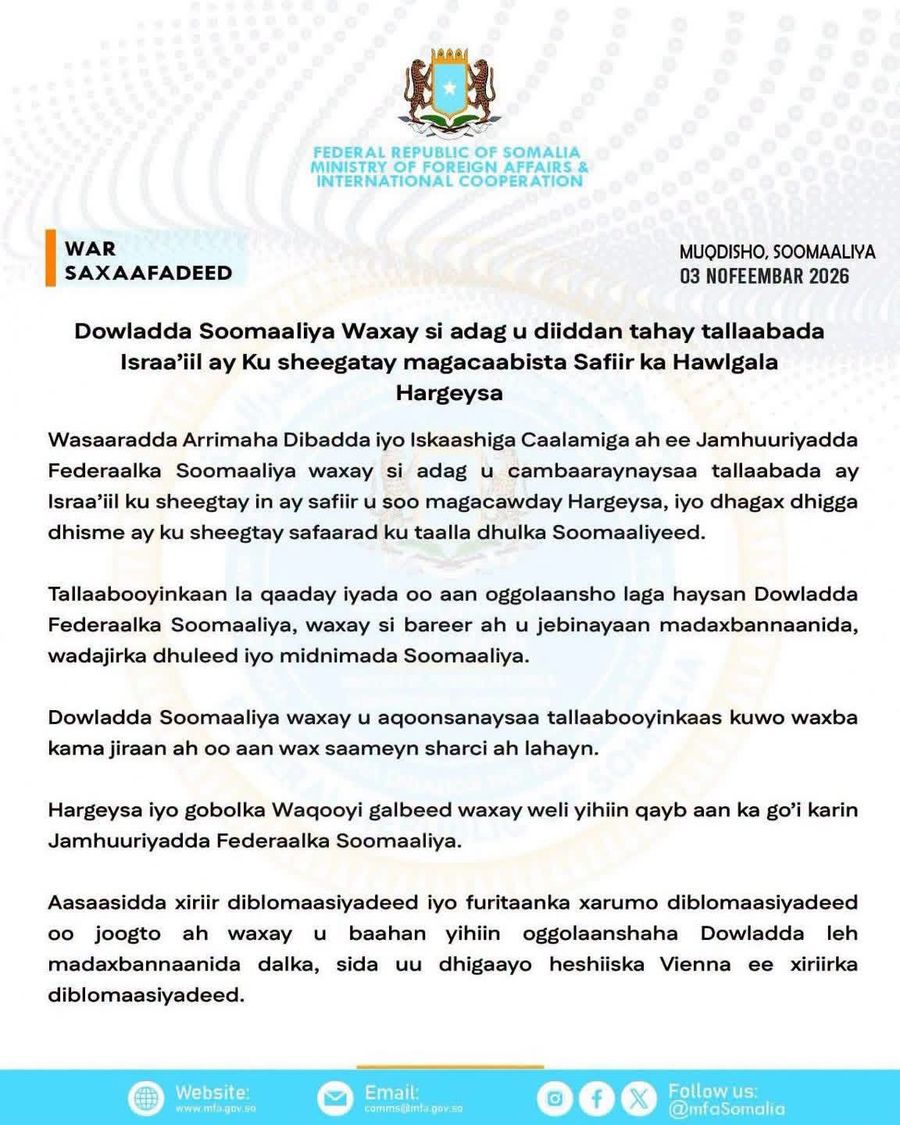
MOGADISHU, Somalia | November 3, 2026 — The Federal Government of Somalia has strongly condemned Israel’s appointment of an ambassador to Hargeisa and the laying of a foundation stone for a proposed Israeli embassy, describing the developments as a serious violation of Somalia’s sovereignty, territorial integrity, and national unity.
In an official statement issued on Tuesday, November 3, Somalia’s Ministry of Foreign Affairs and International Cooperation rejected the diplomatic initiatives, declaring that they were undertaken without the authorization or consent of the internationally recognized Federal Government in Mogadishu.
The ministry described Israel’s actions as legally invalid and insisted that Hargeisa and the wider northwestern regions remain an inseparable part of the Federal Republic of Somalia.
The condemnation marks another escalation in the diplomatic confrontation between Mogadishu and Israel over Somaliland, which declared independence from Somalia in 1991 but remains outside the United Nations as an independent member state.
Somalia Rejects Israel’s Diplomatic Activities in Hargeisa
According to the Foreign Ministry’s statement, Israel’s decision to establish a diplomatic presence in Hargeisa represents an unacceptable challenge to Somalia’s internationally recognized territorial boundaries.
Mogadishu maintained that foreign governments cannot establish diplomatic missions within Somali territory without obtaining authorization from the Federal Government.
The ministry declared that the Israeli diplomatic measures were “null and void” and carried no legal effect under Somalia’s position.
It further emphasized that the establishment of diplomatic relations and permanent diplomatic missions requires the consent of the sovereign state, referring to the Vienna Convention on Diplomatic Relations.
Somalia’s position reflects its longstanding opposition to attempts by foreign governments to recognize Somaliland as an independent country or engage with its authorities in ways that bypass Mogadishu.
The government insists that questions concerning Somalia’s territorial integrity must be addressed within the framework of its constitution and internationally recognized borders.
Israeli Ambassador Presents Credentials in Hargeisa
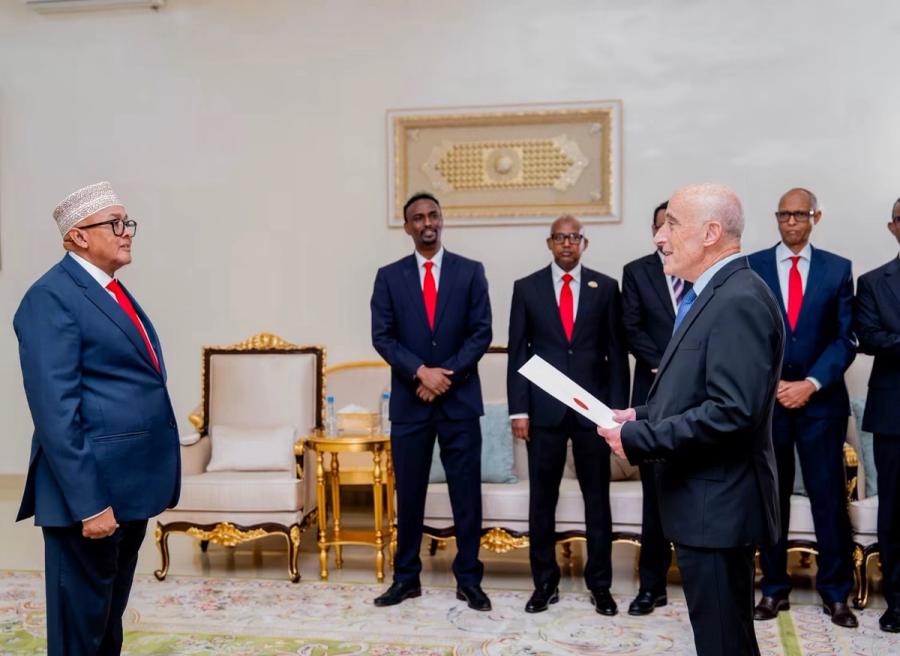
The latest controversy follows the presentation of diplomatic credentials by Israel’s first ambassador to Somaliland, Michael Lotem, to Somaliland President Abdirahman Mohamed Abdullahi, commonly known as Irro.
The ceremony took place at the presidential palace in Hargeisa last week, according to an announcement by Israel’s Foreign Ministry on November 1.
Officials also laid a cornerstone for a planned Israeli embassy, signaling Israel’s intention to establish a permanent diplomatic presence in the city.
Israel recognized Somaliland on December 26, 2025, becoming the first United Nations member state to formally recognize its independence since the territory declared its separation from Somalia in 1991.
Israeli Foreign Minister Gideon Sa’ar has defended the diplomatic relationship, describing the exchange of ambassadors as an important step toward strengthening cooperation between Israel and Somaliland.
However, Somalia continues to reject Israel’s recognition decision and maintains that Somaliland remains part of its sovereign territory.
Growing Diplomatic Confrontation Between Somalia and Israel
The latest dispute highlights increasingly strained relations between Mogadishu and Israel, particularly over Israel’s efforts to expand its political and diplomatic engagement with Somaliland.
Somalia previously condemned Israel’s recognition of Somaliland and opposed subsequent diplomatic visits and appointments involving Israeli officials.
In January 2026, Mogadishu strongly criticized a visit by Israeli Foreign Minister Gideon Sa’ar to Hargeisa, describing it as an unauthorized entry into Somali territory.
The Federal Government has consistently argued that such actions undermine established international principles concerning sovereignty, territorial integrity, and non-interference in the internal affairs of sovereign states.
The November 3 statement reinforces that position, making clear that Mogadishu does not recognize Israel’s diplomatic arrangements with Somaliland as legally valid.
Although Somalia has rejected the developments, Israel and Somaliland have continued to advance their bilateral relationship.
The opposing positions raise questions about the future of diplomatic engagement in the Horn of Africa and whether additional countries might reconsider their relationships with Somaliland.
Somaliland Dispute Raises Concerns Over Regional Stability
Somaliland has operated its own government, security institutions, currency, and electoral system for more than three decades.
Despite exercising considerable self-government, its independence remains disputed internationally, with Somalia maintaining its claim over the territory.
Israel’s recognition has introduced a significant new dimension to that longstanding dispute.
The African Union, Arab League, and Organization of Islamic Cooperation have previously opposed Israel’s recognition of Somaliland, emphasizing support for Somalia’s territorial integrity.
The disagreement also carries broader regional implications because of Somaliland’s strategic position along the Gulf of Aden, close to the Bab el-Mandeb Strait.
This maritime corridor connects the Red Sea with the Indian Ocean and serves as a critical passage for international commercial shipping.
Israel’s growing engagement with Somaliland has therefore attracted attention beyond the immediate dispute over diplomatic recognition.
Somali officials have expressed concerns about the strategic motivations behind Israel’s involvement, while Israeli and Somaliland officials have emphasized opportunities for cooperation in trade, technology, security, and economic development.
These competing perspectives demonstrate how the diplomatic dispute has become intertwined with wider political and security interests in the Horn of Africa.
Mogadishu Insists Hargeisa Remains Part of Somalia
A central element of Somalia’s latest statement is its insistence that Hargeisa and the surrounding northwestern regions remain an integral part of the Federal Republic of Somalia.
The Foreign Ministry emphasized that Somalia’s internationally recognized territorial boundaries cannot be altered through unilateral diplomatic arrangements.
For Mogadishu, the dispute extends beyond the appointment of an ambassador or the proposed construction of an embassy.
It concerns the authority of the Federal Government to represent Somalia internationally and determine the country’s formal diplomatic relationships.
Somaliland’s authorities, meanwhile, regard Israel’s recognition and diplomatic engagement as significant achievements in their longstanding campaign for international recognition.
The sharply contrasting positions suggest that the disagreement is unlikely to be resolved through diplomatic statements alone.
Israel’s diplomatic engagement with Somaliland is continuing despite Somalia’s objections, leaving the two sides firmly divided over the legitimacy of the relationship.