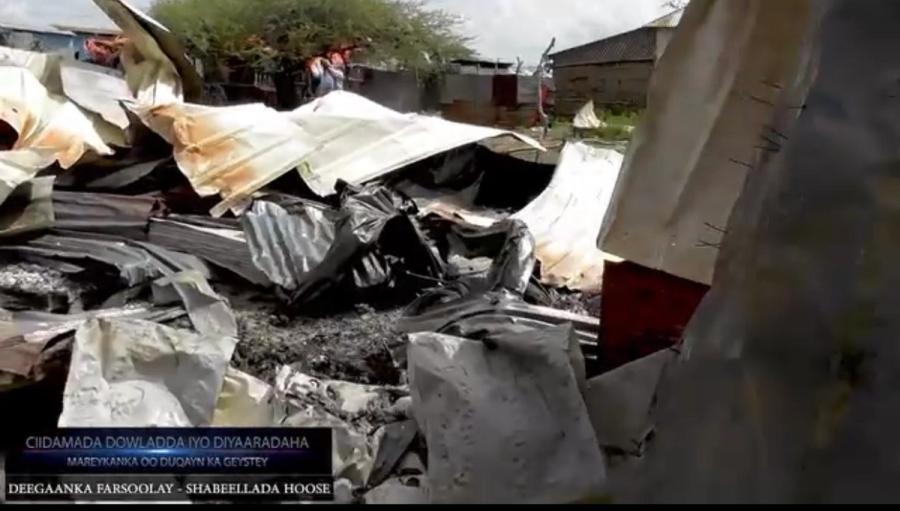
MOGADISHU, Somalia — August 14, 2026 — Suspected US airstrikes destroyed more than eight civilian-owned shops and injured seven members of one family in Farsooley town in Somalia’s Lower Shabelle region, residents said, prompting calls for an investigation and compensation. The military responsible for the reported attack has not been independently identified.
Residents said the strikes hit a section of Farsooley’s civilian market about a week ago, causing extensive damage to shops that provided income for local families.
Seven civilians belonging to the same family were injured, according to accounts from the community. They were taken to Mogadishu for medical treatment, although their conditions were not immediately known.
Video footage obtained from the area showed damaged structures and residents examining the remains of small businesses. The footage alone did not establish which military carried out the attack or the type of aircraft and weapons involved.
Some residents accused US forces operating from the Baledogle military airfield of conducting the strikes. Other accounts suggested that Turkish-operated drones may have been involved.
Neither the US Africa Command, known as AFRICOM, nor the Somali and Turkish governments had publicly claimed responsibility or confirmed an operation in Farsooley at the time of publication. The residents’ allegations could not be independently verified.
Civilian and Economic Impact
Among those affected was a woman who said she was about 70 years old and depended on a small shop destroyed in the attack.
“I had a small shop, and it has been destroyed,” she said in video footage from the town.
The woman said her age and financial circumstances would make it difficult for her to replace what she had lost. Her comments highlighted the economic consequences of the destruction in a community where small shops provide essential income for many households.
Residents said more than seven businesses were destroyed. The total value of the losses has not been assessed, and it was unclear whether local or federal authorities had sent a team to document the damage.
Community members appealed to the United States and Somalia’s other international military partners to take greater precautions during operations against Al-Shabaab.
“We are civilians, not Al-Shabaab,” one resident said. “We ask the Americans to distinguish between civilians and Al-Shabaab members when carrying out strikes.”
No evidence was immediately available showing whether Al-Shabaab fighters or other military targets were present in or near the market when the reported strikes occurred. Residents described the affected location as a civilian commercial area.
No Official Response
Somali authorities had not announced an investigation or identified the force responsible for the attack at the time of publication.
There was also no immediate statement from Lower Shabelle regional officials addressing the reported civilian injuries and property damage.
Baledogle, northwest of Mogadishu, is a major military airfield used by Somali security forces and international partners. US personnel based at the facility have trained and supported the Somali National Army’s elite Danab units during operations against Al-Shabaab.
The United States frequently conducts airstrikes in Somalia in coordination with the federal government. Most American operations target Al-Shabaab in southern and central Somalia or Islamic State militants based in the northeastern Puntland region.
Türkiye is also a major security partner of Somalia. It trains Somali forces and supplies military equipment, while Turkish-manufactured drones have been used during government operations against Al-Shabaab.
Somali government statements sometimes describe air operations as having been conducted with “international partners” without identifying the foreign country involved. That practice can make it difficult for affected communities and independent organisations to establish responsibility for particular strikes.
Previous Civilian Casualty Incidents
Lower Shabelle has recorded previous allegations of civilian casualties during foreign-supported air operations.
In March 2024, two strikes hit Jaffey farm, about three kilometres west of Bagdad village in Lower Shabelle, following fighting between Somali forces and Al-Shabaab.
An Amnesty International investigation concluded that 23 civilians, including 14 children and five women, were killed. Seventeen other civilians were injured.
Amnesty said its weapons specialists examined fragments indicating that Turkish-manufactured MAM-L munitions, which can be launched from TB2 drones, were used. The organisation said it could not determine whether Somali or Turkish personnel controlled the aircraft at the time.
The Somali government said an operation in the area had killed Al-Shabaab militants, but Amnesty called for Somalia and Türkiye to investigate the civilian deaths. Both governments had not responded to the organisation’s questions when its findings were published.
In an earlier investigation into five attacks in Lower Shabelle between 2017 and 2019, Amnesty reported credible evidence that 14 civilians were killed and eight injured. It attributed four of the attacks to US forces and said a fifth was most plausibly caused by an American strike.
AFRICOM disputed some allegations about civilian casualties from its operations. The command later acknowledged that a woman and a child were unintentionally killed in an April 2018 airstrike
The Farsooley allegations could renew scrutiny of foreign air operations in Somalia and the procedures used to identify targets in populated areas. Without an official investigation, it remains impossible to establish which force carried out the reported attack or whether the market was the intended target.
The destruction of several shops could have lasting consequences for families that depend on small-scale trading. Beyond the immediate cost of medical treatment and rebuilding, affected residents could lose their primary source of income.
Failure to identify the force responsible could also deepen mistrust between local communities, the Somali government and its international partners. Civilian casualty allegations may undermine public support for counterterrorism operations, particularly when affected families receive no formal explanation or assistance.
Residents have called for an independent investigation, medical support for the injured and compensation for traders whose businesses were destroyed.