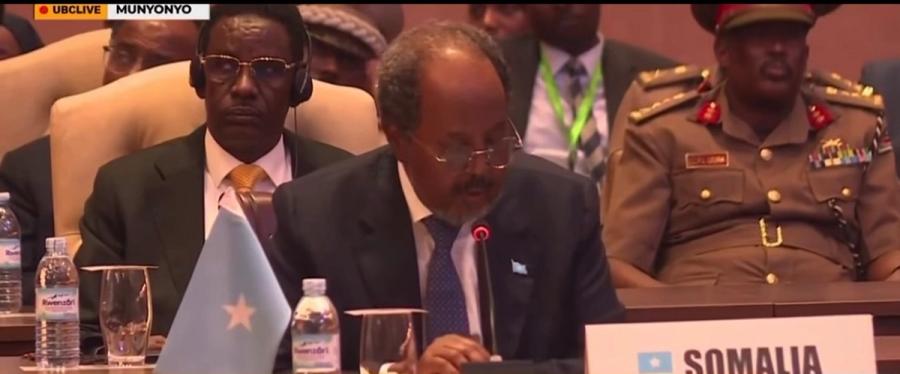
MOGADISHU, Somalia — July 31, 2026 — Somali President Hassan Sheikh Mohamud appeared visibly angry after objecting to a final communiqué issued at the conclusion of the Kampala summit, where participating countries called for an inclusive political agreement in Somalia, sustainable financing for the African Union Support and Stabilization Mission in Somalia (AUSSOM), and a clear roadmap for transferring security responsibilities to Somali forces.
Somali President Hassan Sheikh Mohamud openly criticized the final communiqué issued after the Kampala summit, objecting to language that called for an inclusive political agreement in Somalia, according to participants familiar with the meeting.
The summit, hosted by Uganda, brought together ministers from countries contributing troops to the African Union Support and Stabilization Mission in Somalia (AUSSOM). While the meeting focused primarily on security cooperation and the future of the regional mission, the final communiqué also addressed Somalia’s political transition and governance.
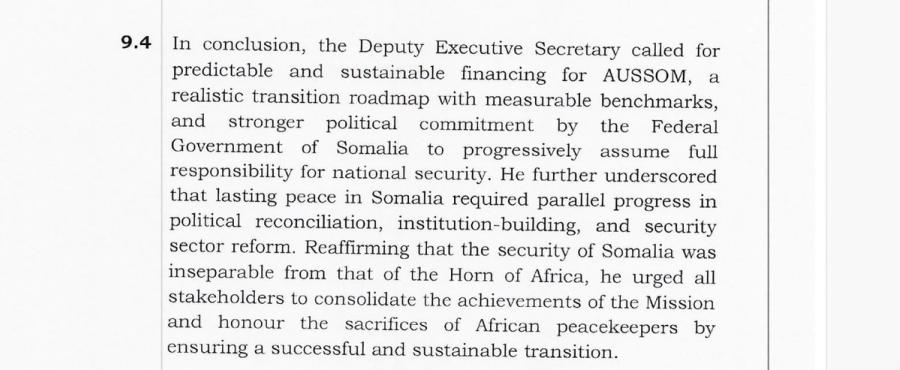
According to the communiqué, participating countries emphasized that lasting peace and stability in Somalia require an inclusive political settlement capable of strengthening state institutions and advancing security sector reforms.
The statement also called for predictable and sustainable financing for foreign forces operating under AUSSOM and urged the development of a credible transition plan with measurable benchmarks that would enable the Federal Government of Somalia to gradually assume full responsibility for security across southern Somalia.
The communiqué further urged the Somali government to demonstrate strong political commitment toward completing the gradual transfer of security responsibilities from African Union forces to Somali security institutions.
According to sources who attended the summit, President Hassan Sheikh strongly objected to the inclusion of the political provisions, arguing that discussions relating to Somalia’s internal political process had not been intended for inclusion in the final statement.
Witnesses at the meeting said the Somali leader delivered remarks during the closing session in which he expressed visible frustration over the wording of the communiqué.
Dispute Over Political Language
According to sources who participated in the summit and spoke to Gaylan Media, representatives had previously reached an understanding that politically sensitive issues concerning Somalia’s internal affairs would not be included in the official communiqué.
Those sources allege that Uganda nevertheless incorporated language calling for an inclusive political agreement before releasing the final statement.
The issue reportedly became more contentious because Ugandan media broadcast portions of the proceedings live, allowing the contents of the discussions and the communiqué to become public immediately. Sources said Villa Somalia viewed the public release of the political provisions as a significant concern.
The Somali presidency had not issued an official response elaborating on the president’s remarks or formally addressing the communiqué by the time of publication.
Regional Security Remains Central
Beyond the political disagreements, the Kampala communiqué reaffirmed that Somalia’s security remains closely linked to the broader security of the Horn of Africa.
Participants urged regional governments and international partners to preserve the gains achieved by AUSSOM while honoring the sacrifices made by African peacekeepers serving in Somalia.
The statement also stressed the importance of ensuring that the transition from African Union forces to Somali security institutions is orderly, sustainable, and based on realistic conditions on the ground.
Officials emphasized that maintaining financial support for the mission remains critical as Somalia continues efforts to expand the capacity of its national security forces.
The Kampala summit took place amid continuing discussions over the future of AUSSOM and the pace at which Somali forces can assume primary responsibility for national security.
International partners have increasingly called for a transition supported by sustainable funding, stronger Somali security institutions, and political consensus among Somalia’s federal and regional stakeholders.
Debate over political inclusivity has intensified in recent months as disagreements persist between the Federal Government and several opposition figures and regional political actors over constitutional reforms, elections, and the country’s broader political direction.
Uganda remains one of the largest troop-contributing countries to the African Union mission in Somalia and has played a central role in regional security efforts for nearly two decades. Kampala has consistently argued that military gains should be accompanied by political dialogue and institution-building to achieve long-term stability.
Notably, the Kampala summit was attended primarily by ministers rather than heads of state, despite expectations that several regional leaders might participate.
The disagreement over the Kampala communiqué highlights the growing connection between Somalia’s security transition and its domestic political process. Regional partners increasingly view political consensus as an essential component of any successful transfer of security responsibilities from African Union forces to Somali institutions.
The communiqué also reflects continued concern among troop-contributing countries over the long-term financing of AUSSOM. Without predictable funding and a clearly defined transition plan, regional officials warn that security gains could become difficult to sustain.
The public disagreement between Somalia and Uganda over the communiqué could complicate future regional coordination, particularly as international partners continue discussions on security assistance, mission financing, and Somalia’s political transition.