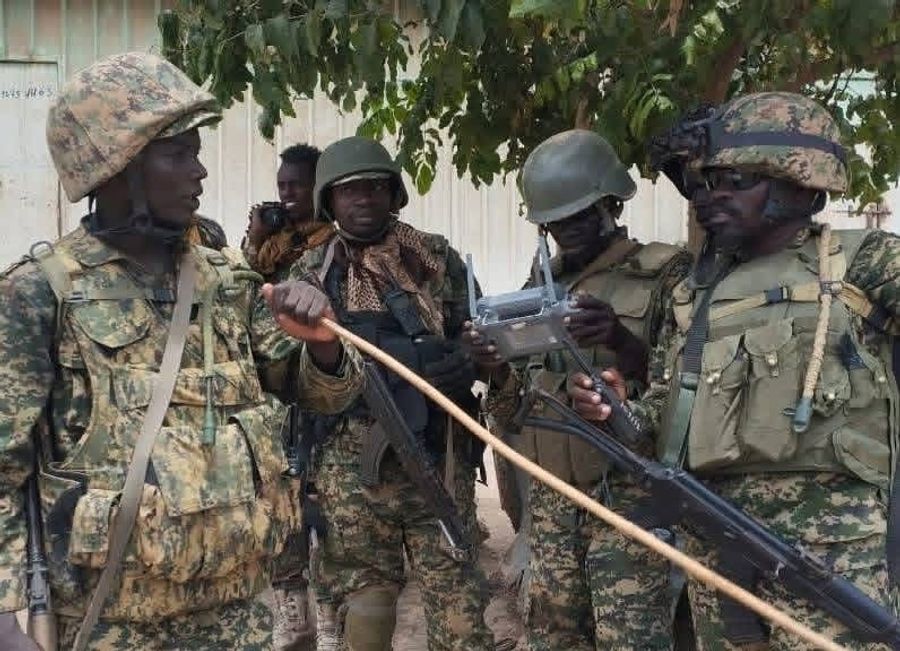
MOGADISHU, Somalia — October 30, 2026-Uganda has begun withdrawing military personnel from Somalia after nearly two decades of involvement in African Union peacekeeping operations, marking a significant development in the country’s security transition as concerns grow over the potential consequences for counterterrorism operations against Al-Shabaab.
A Kenyan-registered aircraft reportedly departed Aden Adde International Airport in Mogadishu carrying 111 Ugandan military personnel, according to information provided to Baidoa Online. The aircraft was identified in the initial report as a Fokker 100 bearing registration 5Y-SKE, although the passenger manifest and aircraft identification have not been independently verified.
The reported evacuation comes as Uganda’s Chief of Defence Forces, General Muhoozi Kainerugaba, publicly confirmed on October 29 that the Uganda People’s Defence Forces (UPDF) had begun withdrawing from Somalia.
In a statement published on X, Kainerugaba said Uganda was transferring security responsibilities to Somali forces after years of military operations and sacrifices. However, he did not disclose the number of troops being withdrawn, their locations, or whether the process would eventually involve Uganda’s entire military contingent.
The announcement provides the clearest official confirmation yet that Uganda’s long-standing military deployment in Somalia is entering a new phase.
Museveni and Hassan Sheikh Hold Crucial Talks in Uganda
The withdrawal follows a high-level meeting between Somali President Hassan Sheikh Mohamud and Ugandan President Yoweri Museveni at State House Entebbe on October 26.
According to the Ugandan presidency, discussions focused on Somalia’s security challenges, the campaign against Al-Shabaab, and bilateral relations.
Reports indicate that Hassan Sheikh sought to persuade Uganda to maintain its military presence for a longer period, particularly in areas where Somali security forces may struggle to assume full responsibility immediately.
Sources cited in the initial reports say Museveni communicated plans to withdraw part of Uganda’s contingent by November 15, 2026. That specific deadline has not been independently confirmed through an official Ugandan withdrawal schedule.
During the meeting, Museveni also emphasized the importance of Somali political unity in defeating Al-Shabaab, arguing that internal divisions have complicated efforts to establish lasting security.
Lower Shabelle Among Areas Facing Potential Withdrawal
The Lower Shabelle region, a strategically important area south and southwest of Mogadishu, is expected to be particularly affected by Uganda’s military drawdown.
Reports have identified Barawe, Bulo Marer, Qoryoley and Janaale among locations potentially affected by the withdrawal arrangements.
Ugandan forces have maintained positions across Lower Shabelle for years, supporting Somali security forces, protecting population centers and securing important transportation routes.
Further evacuations have reportedly been planned for early November, including movements expected around November 4.
The absence of a detailed transition plan has raised concerns about whether Somali security forces will have sufficient personnel, equipment and logistical support to secure the affected areas.
Lower Shabelle remains particularly sensitive because of Al-Shabaab’s continued activity in rural areas and its ability to threaten important routes connecting Mogadishu with southern Somalia.
Any poorly coordinated withdrawal could create opportunities for militants to increase attacks, disrupt transportation or challenge government control in vulnerable locations.
Uganda’s Military Role in Somalia Since 2007
Uganda was the first African country to deploy troops to Somalia under the African Union Mission in Somalia (AMISOM), with its initial contingent arriving in Mogadishu in March 2007.
At the time, Somalia was experiencing prolonged instability, and the internationally recognized government faced serious security threats from armed insurgent groups.
Ugandan troops subsequently played an important role in protecting key government institutions and supporting operations that helped push Al-Shabaab out of much of Mogadishu.
Over the following years, Uganda became one of the most significant contributors to African Union military operations in Somalia, participating in major offensives and stabilization efforts across southern regions.
Its forces also suffered substantial casualties during their deployment, including deaths resulting from militant attacks, ambushes and explosive devices.
The original AMISOM mission was replaced by the African Union Transition Mission in Somalia (ATMIS) in April 2022.
ATMIS was subsequently replaced by the African Union Support and Stabilization Mission in Somalia (AUSSOM), which began operations on January 1, 2025.
AUSSOM was designed to support Somali security institutions while continuing operations against Al-Shabaab and facilitating the gradual transfer of security responsibilities to Somali authorities.
Financial Pressures Complicate African Union Operations
Uganda’s withdrawal is unfolding amid increasing financial uncertainty surrounding the African Union mission.
International funding constraints have placed pressure on the sustainability of AUSSOM, including the financing of troop deployments, equipment, transportation and logistical operations.
The United Nations Support Office in Somalia (UNSOS) provides essential logistical assistance to the African Union mission.
AUSSOM’s current authorization extends through December 31, 2026, under United Nations Security Council Resolution 2809, adopted in December 2025.
Ugandan media have reported that funding reductions and uncertainty over future international support are contributing to the changing military environment.
These financial pressures have intensified questions about how African Union troop-contributing countries can sustain prolonged deployments while Somalia continues building its own security capabilities.
What Uganda’s Departure Could Mean for Somalia
Uganda’s military drawdown presents a significant test for the Somali Federal Government and its security institutions.
For nearly two decades, Ugandan forces have provided military support in some of Somalia’s most strategically important locations.
Their departure could increase pressure on Somali forces to protect military installations, secure transportation corridors and maintain control over areas vulnerable to Al-Shabaab attacks.