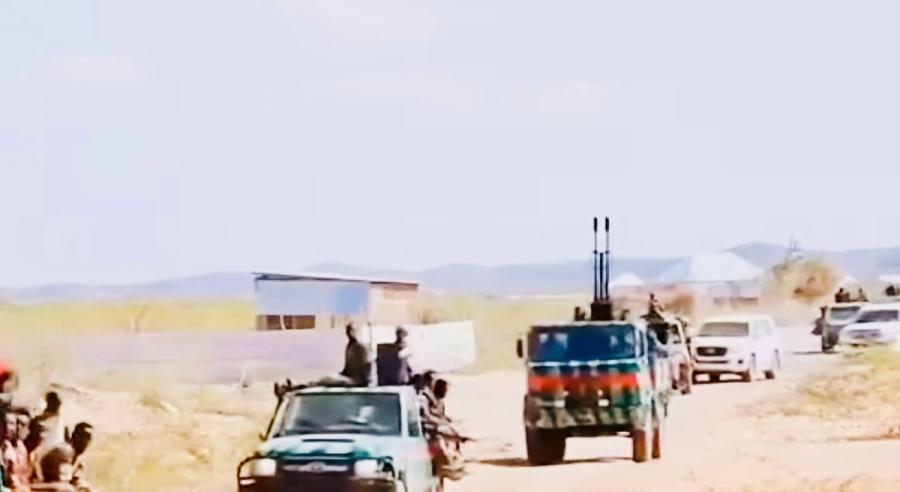
BELEDWEYNE, OCT,30,2026-Somalia — Security tensions have sharply escalated in Beledweyne, the capital of Somalia's Hiiraan region, following reports that several Macawisley militia groups and other armed fighters opposed to the federal government-aligned Hirshabelle administration have entered the city and established defensive positions at strategic locations.
According to local security sources, heavily armed fighters have been deployed across several neighborhoods, with some reportedly patrolling the streets carrying heavy machine guns. Additional reports indicate that heavy weapons have been positioned on the rooftops of certain buildings, while anti-aircraft weapons have allegedly been moved toward Beledweyne airport.
The reported military buildup has heightened fears of a possible confrontation between local armed factions and forces supporting the Hirshabelle administration, as longstanding political disputes over regional leadership, representation and federal government influence continue to deepen.
Security sources say senior Hirshabelle officials aligned with the Federal Government of Somalia postponed their planned arrival in Beledweyne on Friday amid growing opposition from armed groups operating in the city.
The reported postponement follows warnings issued to commercial airlines against transporting officials associated with the federal-aligned administration into Beledweyne.
Political Confrontation Over Hirshabelle Officials' Arrival
At the center of the latest confrontation is the anticipated arrival of Abdifatah Hassan Afrah, a senior Hirshabelle official reportedly elected in Jowhar, the administrative capital of Hirshabelle State.
Armed groups opposing his arrival have reportedly mobilized across Beledweyne, establishing positions intended to prevent federal-aligned regional officials from entering the city.
The latest developments follow an earlier directive attributed to Mohamed Hussein Mohamed Arab, the ousted governor of Hiiraan, who reportedly warned airlines against transporting officials affiliated with the Hirshabelle administration into Beledweyne.
The directive reflects the widening political divide between local factions in Hiiraan and the regional leadership based in Jowhar.
The reported deployment of anti-aircraft weapons near the airport has raised particular concern because of the potential danger to civilian aviation and the possibility that the political dispute could develop into an armed confrontation.
Root Causes: The Gudlawe Leadership Dispute and Hawadle Political Grievances
The roots of the current crisis extend back to the formation of Hirshabelle State in 2016 and the political disputes that intensified following the election of Ali Abdullahi Hussein, widely known as Ali Gudlawe, as Hirshabelle president in November 2020. His election in Jowhar faced strong opposition from influential political figures, traditional elders and sections of the Hawadle clan in Hiiraan, who questioned the legitimacy and inclusiveness of the leadership selection process and accused federal political actors of influencing the outcome.
The dispute reflected longstanding disagreements over power-sharing between Hiiraan and Middle Shabelle, the distribution of senior political positions, control of regional resources and the location of administrative authority. Some Hawadle representatives argued that Hiiraan had been politically marginalized despite its central role in establishing Hirshabelle and contributing to security operations against Al-Shabaab. These grievances contributed to repeated protests, competing political structures and armed opposition movements, including factions associated with General Abukar Haji Warsame, commonly known as General Huud. Although political negotiations and security cooperation temporarily reduced tensions at different stages, the underlying disagreements over representation, local autonomy and federal influence remained unresolved.
The latest confrontation in Beledweyne appears to reflect the continuation of these disputes, with opponents viewing the arrival of federal-aligned officials as an attempt to consolidate political control without securing sufficient local consensus. However, political positions within the Hawadle community are not uniform, and the actions of individual armed factions should not be interpreted as representing the entire clan.
Gudlawe's Re-Election Intensifies the Dispute
The political crisis has entered a more dangerous phase following the re-election of Ali Gudlawe as Hirshabelle president on October 24, 2026, for another five-year term.
Gudlawe secured 81 votes in the regional parliament, while his challenger, Nur Ilmi Halane, received 13. Lawmakers also elected Abdifatah Hassan Afrah as vice president, giving the federal-aligned leadership another term in office despite objections from influential political figures in Hiiraan.
The outcome has intensified opposition among sections of the Hawadle community, whose leaders argue that the presidency should rotate to Hiiraan under the informal power-sharing understanding associated with Hirshabelle's formation.
The dispute is not simply about individual appointments. It concerns the broader question of whether Hiiraan has an equitable share of political authority within a federal member state comprising two historically distinct regions.
Airport Restrictions and Threats to Civilian Security
The confrontation over Beledweyne airport predates the latest armed mobilization.
On September 29, Hawadle traditional elders publicly declared that officials associated with the Hirshabelle administration would not be permitted to land at airports in Hiiraan until a political agreement was reached.
The elders emphasized that ordinary civilian travel should continue, distinguishing their political restrictions from a general closure of the airports.
However, the latest reports of armed deployments and anti-aircraft weapons near Beledweyne airport have raised concerns that the dispute could threaten civilian safety and disrupt transportation.
A report published on October 30 by Banaadir24 also described heavily armed personnel positioned across Beledweyne, including weapons reportedly placed on building rooftops, as opponents sought to prevent Vice President Abdifatah Afrah's arrival.
The reported postponement of the officials' visit has not resolved the underlying political confrontation.
Macawisley Militias and the Risk to Counterterrorism Operations
The involvement of Macawisley fighters adds another dimension to the crisis.
Macawisley militias have played an important role in local security and military operations against Al-Shabaab, particularly during the counteroffensives launched in Hiiraan in 2022.
Their participation helped strengthen government-backed operations in areas where local communities had organized armed resistance against the militant group.
However, political divisions involving local militia factions could complicate security coordination and divert attention from ongoing counterterrorism efforts.
The possibility of armed confrontations between groups that have previously shared an interest in combating Al-Shabaab presents a significant challenge for both regional and federal authorities.
Political instability in Hiiraan could also create opportunities for Al-Shabaab to exploit weakened security arrangements, although there is no confirmed evidence linking the militant organization to the current political mobilization.
Fears of Armed Confrontation Grow
The latest developments underline the fragility of the relationship between the Hirshabelle administration and influential political and traditional leaders in Hiiraan.
With armed groups reportedly occupying defensive positions, political leaders exchanging warnings and regional officials postponing their arrival, the possibility of an escalation remains a serious concern.