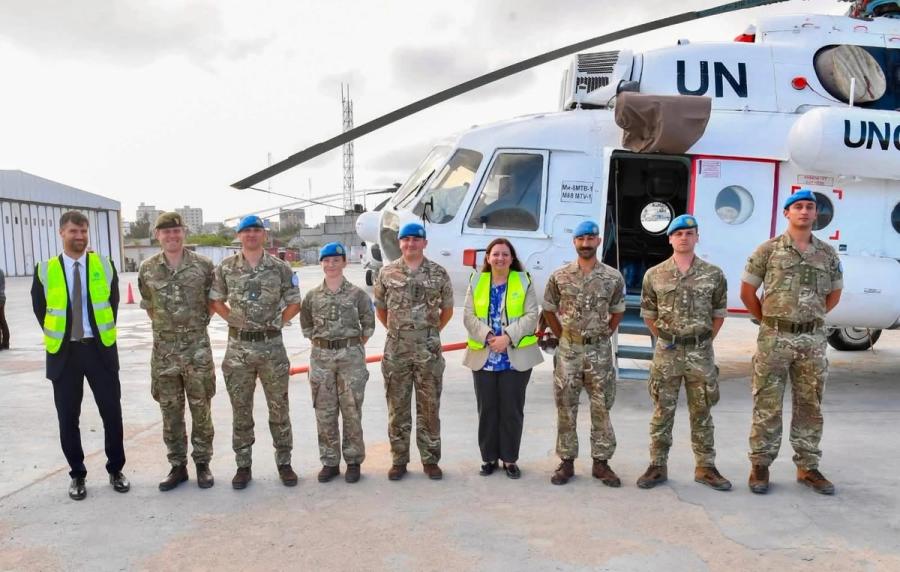
MOGADISHU | November 6, 2026 - The United Nations Security Council is scheduled to hold a closed-door meeting on Somalia on November 18, 2026, amid mounting concerns over the country's deteriorating security environment, escalating political divisions, and growing uncertainty surrounding the future of international peacekeeping and stabilization efforts.
The meeting comes at a critical moment for Somalia, where tensions between the Federal Government and several Federal Member States have intensified, raising concerns about the country's political stability, electoral process, and ability to sustain military operations against the Al-Qaeda-linked militant group Al-Shabaab.
According to the Council's provisional November programme, discussions are expected to focus on the African Union Support and Stabilization Mission in Somalia (AUSSOM), challenges surrounding its financing, and the international sanctions regime targeting Al-Shabaab.
The meeting is scheduled for November 18 at 10:00 a.m. New York time and is listed as a private session rather than a formally designated emergency meeting.
Growing Political Divisions Threaten Somalia's Stability
Somalia continues to face significant political challenges as disagreements over constitutional amendments, electoral arrangements, and the distribution of power between the Federal Government and regional administrations deepen.
Relations between Mogadishu and the administrations of South West State, Puntland, and Jubaland have become increasingly strained, highlighting longstanding disagreements over federal authority, political representation, and the country's future governance structure.
These divisions have raised concerns about the prospects for political reconciliation and the ability of Somali leaders to reach consensus on major national priorities.
Political observers warn that prolonged disputes between federal and regional authorities could undermine efforts to strengthen national institutions, coordinate security operations, and prepare for future elections.
The political uncertainty also comes as Somalia continues to depend heavily on international assistance to support its security institutions and maintain stabilization efforts across areas affected by militant violence.
AUSSOM Funding Crisis Raises Security Concerns
One of the central issues expected to feature in the Security Council discussions is the future of the African Union Support and Stabilization Mission in Somalia.
AUSSOM plays a significant role in supporting Somali security forces, protecting key infrastructure, and assisting operations aimed at countering Al-Shabaab.
However, financial challenges and uncertainty over sustainable international funding have raised concerns about the mission's long-term operational capacity.
Any reduction in financial support or operational capabilities could place additional pressure on Somali security forces, particularly in areas where African Union troops continue to provide essential security assistance.
The Security Council is expected to consider these challenges as international partners assess the future of stabilization efforts and Somalia's ability to assume greater responsibility for its own security.
Al-Shabaab Threat Remains a Major Challenge
The continuing threat posed by Al-Shabaab is another major concern as Security Council members prepare to discuss Somalia's security situation.
Despite years of military operations involving Somali forces and international partners, the militant organization remains capable of conducting attacks, disrupting transportation routes, and threatening communities across parts of southern and central Somalia.
Persistent insecurity has complicated humanitarian access, economic activity, and government efforts to extend administrative authority into contested areas.
The Council is also expected to consider the renewal of sanctions measures targeting Al-Shabaab, with the current sanctions framework approaching its November 30 deadline.
These measures are intended to restrict the group's access to weapons, financial resources, and other forms of support that could strengthen its operational capabilities.
Somalia Enters a New Phase Following UN Mission Transition
The November meeting follows the scheduled conclusion of the United Nations Transitional Assistance Mission in Somalia (UNTMIS) on October 31, 2026.
The transition marks an important stage in the evolving relationship between Somalia and the United Nations, with increasing emphasis on Somali ownership of political, governance, and security responsibilities.
However, the transition also raises questions about the continuity of international assistance at a time when Somalia continues to face considerable institutional and security challenges.
The Security Council's deliberations could provide further insight into how international partners intend to coordinate support for Somalia following the mission's closure.
International Attention Turns to November 18 Meeting
The upcoming Security Council session comes amid growing concerns that Somalia's political disputes and security challenges could reinforce one another, complicating efforts to achieve lasting stability.
Although the meeting is expected to focus primarily on AUSSOM and Al-Shabaab sanctions, the wider political and security environment is likely to provide important context for the discussions.
The outcome will be closely watched by Somali political leaders, regional administrations, international partners, and communities affected by years of conflict.
With political tensions unresolved and security challenges continuing, the November 18 meeting represents another important opportunity for the international community to assess Somalia's stability and the future of international engagement in the country.