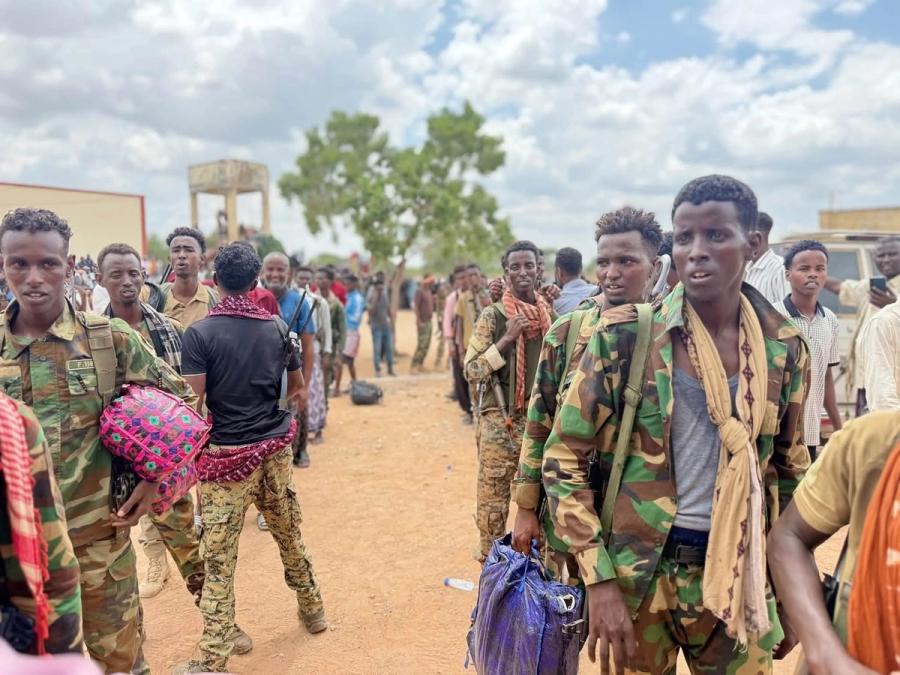
BELEDWEYNE, Somalia | November 7, 2026-Political and security tensions have sharply escalated in Somalia’s Hiiraan region after the supreme traditional leader of the Hawadle clan, Ugaas Yusuf Ugaas Hassan, called on soldiers from his community serving in the Somali National Army (SNA) to abandon their frontline positions and return to Beledweyne to defend their people, dignity and territory.
The unprecedented appeal comes amid a deepening confrontation between influential Hawadle politicians, traditional elders, the Hirshabelle regional administration and Somalia’s Federal Government, raising serious concerns about divisions within the country’s security institutions.
Gorgor Commandos Reportedly Leave Jowhar Following Ugaas’s Appeal
According to emerging local reports, members of the Somali National Army’s elite Gorgor commando units, originally from Beledweyne and other parts of Hiiraan, have reportedly departed Jowhar and positions in the Middle Shabelle region to join forces supporting the Hawadle traditional leader.
The soldiers are said to have responded directly to the Ugaas’s overnight appeal, which urged Hawadle personnel serving in federal security institutions to return home rather than participate in military operations against their communities.
The number of Gorgor personnel involved remains unclear, and there has been no official confirmation from the Somali National Army’s leadership regarding the reported troop movements.
the departures would represent a significant challenge to military cohesion at a time when Somalia’s armed forces are already facing considerable security pressures.
NISA Personnel and Military Forces Gather at Ugaas’s Residence
Meanwhile, reports from Beledweyne indicate that armed personnel from the National Intelligence and Security Agency (NISA), alongside regular military soldiers, have gathered at the residence of Ugaas Yusuf Ugaas Hassan.
A military pickup truck carrying heavily armed NISA personnel reportedly arrived at the traditional leader’s compound, where the soldiers joined Macawiisley community fighters providing security.
Additional military personnel were also reported to have assembled around the residence following the Ugaas’s call for mobilization.
The developments suggest that the traditional leader is attracting support from armed personnel associated with different branches of Somalia’s security establishment.
Ugaas Accuses Federal Authorities of Deploying Clan-Based Forces
Speaking during a late-night address, Ugaas Yusuf Ugaas Hassan accused individuals operating under the authority of the Federal Government of preparing military action against communities in Hiiraan.
He described the alleged deployment as a threat to the dignity, security and existence of the region’s population.
The traditional leader called on Hawadle soldiers serving across Somalia’s military fronts to return to Hiiraan and defend their communities.
His remarks followed reports of federal troop movements toward the region, where opposition politicians and lawmakers have challenged both Mogadishu’s political approach and the legitimacy of the recently established Hirshabelle leadership.
The Ugaas’s accusations have intensified an already sensitive political dispute, although the Federal Government has not publicly substantiated or accepted claims that its deployments are intended to target a particular community.
Macawiisley Fighters Reportedly Block Lama-Galay Access Road
In another development, Macawiisley fighters in Beledweyne reportedly blocked an access road leading toward the Lama-Galay administrative compound amid reports concerning the movements of Hirshabelle Vice President Abdifatah Hassan Afrah.
The road restrictions were reportedly introduced after local armed groups received information that the vice president was heading toward the area.
Lama-Galay has become a central location in the political confrontation after community fighters moved into parts of the regional administration compound in late October.
The disputed complex houses important administrative offices and military facilities, making control of its entrances particularly sensitive.
The reported restrictions highlight the deteriorating relationship between Hirshabelle authorities and armed groups aligned with local political opponents.
Federal Reinforcements Reportedly Moving From Galgaduud
Separate reports indicate that federal troops previously stationed around Xananbuure in the Galgaduud region have been mobilized and are moving toward Beledweyne through the Dhuusamareeb area.
The forces are reportedly being deployed amid the growing confrontation involving Hirshabelle officials and their opponents in Hiiraan.
The possibility of additional armed units entering Beledweyne has heightened fears that political disagreements could develop into a broader military confrontation.
Hirshabelle Leadership Dispute Fuels Regional Instability
The current crisis follows the controversial October 24 re-election of Ali Abdullahi Hussein Guudlaawe as Hirshabelle president and the election of Abdifatah Hassan Afrah as vice president.
Influential Hawadle politicians and traditional elders have rejected the electoral process, arguing that it failed to address longstanding concerns over political representation, power-sharing and consultation with communities in Hiiraan.
Former NISA Director and federal lawmaker Abdullahi Mohamed Ali, widely known as Sanbaloolshe, has also emerged as a prominent opponent of the current Hirshabelle political arrangement.
His arrival in Beledweyne, accompanied by armed supporters, has further complicated the security situation.
Vice President Afrah, meanwhile, has defended his visit to Beledweyne as an effort to engage local elders and address grievances through dialogue.
Growing Fears of Armed Confrontation
The simultaneous presence of rival armed groups, federal security personnel, influential politicians and traditional leaders has placed Beledweyne at the center of an increasingly dangerous political standoff.
The reported movement of Gorgor commandos and NISA personnel toward the Hawadle Ugaas’s residence raises additional questions about command authority, political loyalties and the ability of Somalia’s security institutions to remain united during internal disputes.